Blog

Your blog category

Blog

Adaptability and Business Performance: What Research Shows

Business consultants have insisted for years that adaptability drives performance, which is exactly the kind of claim that deserves a sceptical look rather than automatic acceptance. Adaptability and business performance have been tested statistically across dozens of studies and thousands of firms, and the honest answer is more nuanced than what consultants or sceptics usually present. What a Meta-Analysis Actually Found The most rigorous evidence comes from combining many individual studies into one statistical estimate, which smooths out the noise any single study carries on its own. A meta-analysis published in PLOS ONE, screening 6,436 studies down to 72 empirical ones, found organisational agility correlated with firm performance at r equals 0.31 to 0.33, a moderate, statistically real relationship rather than either a negligible one or an overwhelming one. In plain terms, a correlation in that range means adaptability is a genuine, measurable contributor to performance, but it’s one factor among several, not the single dominant driver some business books imply. Adaptability and business performance are connected. The connection just isn’t as overwhelming as the marketing language around organisational agility often suggests. The Direct Path From Adaptability to Performance More recent research has moved from simple correlation toward modelling the actual causal pathway. A 2026 study using structural equation modelling found that dynamic capability, the organisational ability to sense change and reconfigure resources in response, had a statistically significant direct effect on business performance, with a path coefficient of 0.600 and a t-statistic of 5.398, a result that clears the standard threshold for statistical significance comfortably. That’s a stronger, more specific finding than a broad correlation, since it isolates dynamic capability as a driver of performance while statistically accounting for other variables in the same model. It’s one of the clearer pieces of evidence that this isn’t just two things that happen to move together; there’s a demonstrable directional relationship between them. Why the Connection Runs Through Data and Decisions, Not Just Culture Adaptability is often described in vague, cultural terms- comfortable with change, open to new ideas- which makes it hard to study rigorously. Newer research has instead traced a more concrete mechanism. A 2025 meta-analysis published in Humanities and Social Sciences Communications found that organisational agility acts as a mediating mechanism between a company’s big data analytics capability and its financial performance, meaning better data infrastructure improves performance specifically by enabling faster, more adaptive decisions, rather than improving performance directly on its own. This matters practically: a company that invests heavily in data and analytics tools without building the organisational structure to act on what that data shows quickly is missing the actual mechanism that converts data into results. The technology alone doesn’t do the work. The adaptability built on top of it does. Human Capital Sits Underneath the Whole Chain It’s worth tracing the mechanism one layer further back, since adaptability doesn’t appear inside an organisation from nowhere. A 2026 study of corporate managers found strategic human capital had a significant positive effect on dynamic capabilities, with a path coefficient of 0.765, and dynamic capabilities in turn significantly predicted organisational agility, with a path coefficient of 0.582, tracing a full chain from workforce quality through organisational capability to the agility that ultimately correlates with performance. This adds a useful, practical layer to the adaptability and business performance question: agility isn’t a policy a company simply announces; it’s downstream of whether the organisation has actually built the underlying human capital and reconfiguration capacity needed to produce it in the first place. A company trying to become more adaptive without investing in the people and capability layer underneath it is skipping the part of the chain the research shows actually does the work. Startups Show the Same Pattern in a Different Setting The relationship isn’t confined to large, established firms either, and evidence from earlier-stage companies reinforces the same conclusion from a different angle. A synthesis of research on international startups found that dynamic marketing capabilities, paired with strong information management, correlated with faster growth, stronger market responsiveness, and a more durable competitive advantage across the ventures studied. That finding matters for the adaptability and business performance question specifically because startups operate with far less institutional inertia than large corporations, which means the relationship shows up more cleanly: a young company either builds the capacity to sense and respond to its market quickly, or it doesn’t, without decades of legacy process and culture complicating the picture the way it does at a mature enterprise. Seeing the same directional relationship hold in both settings, small and fast-moving as well as large and established, is part of what makes the underlying finding credible rather than an artefact of one specific type of company being studied disproportionately. The Correlation Isn’t Uniform Across Every Company It would be misleading to present this relationship as fixed and identical everywhere, since the same body of research finds it varies by context. The relationship between agility and performance has been shown to differ across national cultures, industries, and firm sizes, with some studies finding the link considerably stronger in fast-moving, technology-exposed sectors than in stable, slow-changing ones. A firm’s starting point matters too: a company already operating close to its industry’s competitive frontier gets less incremental benefit from additional agility than one that’s currently lagging and has more room to close a gap. Adaptability and business performance move together more strongly in some environments than others, which is exactly what a genuinely evidence-based claim should look like, rather than a universal law applying equally to every company in every market. What ‘Real’ Means Here: Effect Size in Context It’s worth being precise about what a correlation of roughly 0.3 actually implies, since the number itself can be misread in both directions. In social science and management research, a correlation in that range is generally considered a moderate effect, meaningfully different from zero and worth acting on, but far short of the kind of relationship where adaptability alone could be expected to explain most of the


Blog

How a Job Prepares You to Start a Business, By the Data

The image of a founder is usually someone who skipped the traditional career path entirely, but the actual research on who builds successful businesses tells a different story. How a job prepares you to start a business turns out to be one of the more thoroughly studied questions in entrepreneurship research, and the data consistently favours the person who spent real years working for someone else first. The Data Behind How a Job Prepares You to Start a Business The clearest evidence comes from a landmark study using US Census and IRS data covering 2.7 million founders. Research by MIT’s Pierre Azoulay and coauthors found the average founder age among the fastest-growing one-in-a-thousand new ventures was 45, and separately found that entrepreneurs were 125 per cent more successful when they had previously worked in the specific industry they went on to found a company in. Neither finding fits the popular image of the twenty-something dropout founder. Both point toward the same underlying mechanism: years spent employed inside an industry build something a great idea alone can’t replace. Why Industry-Specific Experience Matters So Much The advantage isn’t vague or hard to explain once it’s broken down. Research from Nanyang Business School found startups founded by people with related prior industry experience consistently perform better because those founders already understand market trends, customer needs, and competitive dynamics before they ever write a business plan. A job inside an industry is, in effect, years of paid market research: which customer complaints are common, which processes are inefficient, which competitors are vulnerable, and which parts of the industry’s standard playbook are actually wrong. None of that shows up on a resume as a skill, but it’s precisely the knowledge a founder needs to identify a real gap rather than guess at one from the outside. The Specific Skills a Job Actually Builds Beyond industry knowledge, ordinary employment builds a set of concrete, transferable capabilities that new founders often have to learn the hard way if they skipped this stage. Negotiating a vendor contract, managing a budget against a hard ceiling, hiring and giving feedback to a direct report, handling a genuinely upset customer, and running a project against a deadline with resources that keep shifting are all skills a job forces someone to practice repeatedly, in a setting where the consequences of a mistake are contained rather than existential. A first-time founder who has never managed a budget, negotiated a contract, or given a direct report difficult feedback is learning all of those skills for the first time at exactly the moment the business can least afford the mistakes that come with a first attempt. Where Job Experience Can Become a Liability It would be dishonest to present this as an unqualified benefit, since the same research identifies a genuine downside. Industry experience helps most in a startup’s early stages, but its positive impact diminishes over time as the founding team accumulates new, venture-specific knowledge, and in some cases prior experience becomes a liability, producing overconfidence and reduced flexibility exactly when a startup needs to pivot away from what worked at a previous employer. How a job prepares you to start a business isn’t a guarantee that more years of experience is always better. A founder who spent fifteen years doing things one company’s way can struggle precisely because they’re too certain that way is the only way, which is its own kind of risk a completely inexperienced founder doesn’t carry. Background Isn’t Everything, and That’s Worth Being Honest About It’s worth adding one more genuine caveat rather than overselling this pattern. A 2025 analysis of more than 4,300 Y Combinator companies found founder background explained less than 4 per cent of the variation in how much funding a startup ultimately raised, and prior experience at a large, well-known tech company specifically was not a reliable predictor of funding outcomes at all, with the effect reversing direction depending on how the analysis was run. That doesn’t contradict the industry-experience research above, since funding raised and long-term business success are genuinely different outcomes, but it’s an important corrective to the idea that a prestigious employer name alone functions as a guarantee. What predicts success isn’t simply which company appears on a resume; it’s whether the specific years spent there built real, applicable knowledge of the market the founder eventually enters. Why a Mix of Experience Beats One Type Alone Research specifically on founding teams adds an important nuance to the industry-experience finding. A University of Wisconsin study using Census Bureau employment data found startups with a combination of founders holding different types of prior experience, some with experience across multiple firms, others with shared experience working together at the same previous company, had meaningfully better odds of long-term survival than teams built around a single experience profile. This lines up with a broader pattern in the founder-background research: diversity within a founding team’s collective experience tends to outperform uniformity, since different backgrounds cover each other’s blind spots in a way that a team built entirely from the same prior employer or the same functional background can’t. Why Middle-Aged Founders Keep Outperforming Younger Ones It’s worth returning to the age finding directly, since it’s often misread as a claim about biology rather than about accumulated experience. The Azoulay research isn’t suggesting people become inherently better entrepreneurs as they age; it’s showing that the specific advantages built up over a longer career, deeper industry knowledge, a larger professional network, more capital saved to self-fund an early stage, and more management experience, happen to accumulate with time spent employed. A separate University of Glasgow study of Scottish tech startups found ventures founded by mid-career professionals coming from established companies were more likely to become high-growth firms than university spinoffs, specifically because those founders had already built real relationships with end users and customers during their time in traditional employment. Age itself isn’t the mechanism. Years spent building exactly the kind of experience described throughout this piece are.

Blog

First Export Order Checklist for New Exporters

An inquiry from a buyer overseas is exciting enough that the instinct is to reply with a price as fast as possible, before someone else does. That instinct is exactly what causes most of the expensive mistakes new exporters make. A first export order checklist exists precisely because the gap between receiving an inquiry and sending a number back is where the real risk sits, not in the shipment itself. First Export Order Checklist: Verify the Buyer Before Anything Else Gets Calculated This is the step most new exporters skip entirely, and it’s the one with the highest cost attached when it goes wrong. A 2025 survey found 78 per cent of companies had experienced at least one fraud attempt in the previous two years, with fake buyer fraud- a fraudster impersonating a legitimate customer- accounting for 24 per cent of reported business fraud cases. The common patterns are specific enough to check for directly: a buyer who rushes the negotiation and skips normal due diligence steps, contact details that change mid-conversation, or a company that can’t produce basic verification, business registration, a working landline, or a real physical address when asked. Checking a buyer’s registration against their country’s official company registry, verifying their listed address independently, and being wary of any importer pushing to skip standard verification because the deal is urgent takes less time than building a full quotation and can prevent a shipment that never gets paid for at all. Watch for the Specific Fraud Patterns, Not Just a General Feeling Beyond checking a buyer’s registration, it helps to know the specific mechanics fraud tends to follow, since the patterns are consistent enough to be checked for directly rather than relying on instinct alone. Documented fraud patterns in export trade include the phoney buyer who places a large order and disappears after receiving goods without paying, business email compromise where a scammer impersonates a supplier or buyer to redirect payment to a fraudulent bank account, and overpayment scams where a buyer sends funds exceeding the invoice amount and requests the difference be wired back before the original payment bounces. Any bank account change communicated only by email, without a verifying phone call to a number already on file, is worth treating as a red flag by default rather than an inconvenience to double-check. This single habit, confirming payment details through a second channel before acting on them, closes off the business email compromise pattern specifically, which is among the most common and costly of the three. Confirm the Product Specification Is Actually Complete A quotation built on an incomplete specification is a quotation that will likely need revising, and every revision after a price is already on the table weakens an exporter’s negotiating position. Exact quantity, packaging type and unit count, the specific quality standard or certification the buyer expects, and the delivery timeline all need to be pinned down in writing before a number gets attached to any of it. This is also the point to confirm the correct HS classification for the product, since pricing a shipment before knowing its actual duty and compliance category risks quoting a landed cost that turns out to be wrong once the real classification is confirmed later. Check Whether the Product Even Needs a License to Ship Before a quotation goes out, it’s worth confirming the product itself isn’t sitting in a restricted or licensed category, since discovering this after a price has already been agreed creates an awkward, expensive conversation with a buyer who’s already expecting delivery on a fixed timeline. Certain product categories, chemicals, electronics with dual-use potential, pharmaceuticals, and anything on a government-maintained restricted list, require an export license or additional documentation before they can legally ship at all, regardless of how straightforward the commercial terms look. Checking a product’s classification against the relevant restricted list takes a few minutes and costs nothing. Discovering the restriction after a shipment is already booked, packed, and paid for by the buyer costs considerably more, both in direct fees and in the time lost renegotiating a deal that seemed finished. Decide the Incoterm Before Calculating the Price, Not After Incoterm choice isn’t a detail to settle after the price is agreed; it’s an input the price actually depends on. Quoting FOB puts freight, insurance, and most of the risk from the port of origin onward on the buyer, while quoting CIF or DDP keeps that same risk and cost with the exporter all the way to the buyer’s door or a named destination port. A price quoted without a clearly stated Incoterm invites exactly the kind of dispute that surfaces weeks later, when the buyer assumed one cost structure and the exporter assumed another, and by then the number itself has often already been informally agreed to. Build the Landed Cost Correctly, Not Just the Product Cost A quotation based only on manufacturing or procurement cost, without accounting for freight, insurance, packaging, inland transport, and bank charges tied to the agreed payment method, routinely underprices a shipment in ways that only become visible after the goods have already shipped. International wire transfers alone can lose several percentage points to combined bank fees and exchange rate margin, an amount that needs to be built into the quoted price rather than discovered as a surprise deduction once payment finally arrives. Calculating the full landed cost before quoting, not just the cost of the product sitting in a warehouse, is what actually protects the margin a quotation is supposed to represent. Decide Payment Terms Before Quoting, Not After the Buyer Pushes Back Payment terms shape how much risk an exporter is actually carrying, and deciding them reactively, after a buyer has already pushed for open account terms mid-negotiation, puts an exporter in a weaker position than deciding them upfront. Advance payment protects the exporter fully but isn’t realistic for every relationship. A letter of credit shifts payment risk to the buyer’s bank at the cost of tighter documentary compliance. For a

Blog

What Students Should Learn in the AI Era, By the Research

Any student with a phone can now get a clear, patient explanation of almost any concept in seconds, which raises a genuinely uncomfortable question for anyone still designing a curriculum. What students should learn in the AI era isn’t really a question about which subjects to add or drop. The research points somewhere more specific: toward how learning actually happens, not just what gets covered. What Students Should Learn in the AI Era: The Skill Already Missing Before addressing what to add, it’s worth being honest about what current AI use is already doing to a skill schools were supposed to be building. A 2025 MIT Media Lab study using EEG found the group writing essays with AI assistance showed the weakest neural connectivity of any condition tested, and a separate 2025 study of 666 participants found a statistically significant link between frequent AI tool use and lower scores on standardised critical thinking tests. This isn’t a hypothetical concern for later. It’s a live pattern showing up in students using these tools right now, which is exactly why the question of what to teach differently has become urgent rather than theoretical. What Younger Students Need Looks Different From Older Ones The right balance between AI assistance and unaided practice isn’t the same at every stage of schooling, and treating it as one uniform policy misses an important distinction. Foundational skills- basic arithmetic, sentence construction, early reading fluency- are the mental building blocks that later, more complex reasoning depends on, and researchers in cognitive development have long argued these need to be practised directly rather than offloaded early, since a student who never automates basic calculation will struggle to reason about algebra later regardless of how good the AI explanation of algebra happens to be. Older students working on synthesis, argumentation, or applying a concept across unfamiliar contexts are in a genuinely different position, since AI can reasonably serve as a thinking partner there without undermining a foundation that’s already been built. The mistake many curriculum debates make is applying one blanket rule, either full AI access or none, across both of these very different learning stages at once. Why Watching AI Explain Something Isn’t the Same as Learning It Cognitive science has a specific, well-established answer for why passively reading a clear AI explanation doesn’t produce durable learning, even when it feels like it should. Roediger and Karpicke’s foundational 2006 research established the testing effect: actively retrieving information from memory produces significantly stronger long-term retention than rereading or passively reviewing the same material, and Karpicke and Blunt’s 2011 follow-up found retrieval practice outperformed even active elaborative techniques like concept mapping. The mechanism researchers call desirable difficulty explains why: the extra cognitive effort required to pull an answer out of memory, rather than have it handed over already formed, is precisely what builds the durable mental structure. A perfect AI explanation removes that effort entirely, which means it can make a concept feel understood in the moment while doing very little to make it retrievable later- the exact gap a test or a real-world problem eventually exposes. The OECD’s 2026 Framework for What Actually Matters Now Education policy has started catching up to this distinction directly. The OECD’s 2026 AI literacy framework identifies critical thinking, source verification, ethical judgment, digital safety, and the specific ability to work independently without AI assistance as the core competencies schools need to build deliberately, explicitly warning that AI should help a student think rather than think in place of the student. That last competency, working independently without AI, is easy to overlook but may be the most practically important one for what students should learn in the AI era: a student who has never practised solving a problem unaided has no baseline to notice when an AI-generated answer is subtly wrong, incomplete, or simply doesn’t apply to their specific situation. Why This Also Matters Once Students Reach the Workforce This isn’t purely an academic concern that resolves itself once school ends, since the same gap follows students directly into hiring decisions. NACE’s 2026 Job Outlook survey found employers rated communication skills as important 98.7 per cent of the time, but only 55.4 per cent of recent graduates were actually judged proficient at it, a 43-point gap, and separate 2026 labour market data found soft skills, including critical thinking and judgment, now account for seven of the ten fastest-growing skills employers are hiring for. Students who leaned on AI to produce polished coursework without building the underlying judgment to evaluate, defend, or improve on that output are arriving at exactly the moment employers have started testing directly for that missing piece, whether through skills-based hiring assessments or interview formats built specifically to check whether a candidate can explain their own reasoning rather than just present a finished answer. The Skills That Were Already the Point It’s worth noting a genuinely contrarian position in this debate, one worth taking seriously rather than dismissing. Some education researchers argue AI changes remarkably little about what fundamentally needs teaching, pointing back to a framework built over a decade ago around critical thinking, communication, collaboration, and creativity as the durable core of what school was always supposed to build, regardless of what tool happens to be available for looking things up. Under this view, the mistake isn’t the curriculum; it’s continuing to organise instruction and assessment around information recall long after a tool existed that makes recall nearly free. What students should learn in the AI era, in this reading, was already the right answer before AI arrived. The technology has just made it considerably harder to keep avoiding that shift. Teachers and Curriculum Design Need to Shift Too None of this responsibility should sit purely on individual students, since a curriculum still built around take-home assignments an AI tool can complete in seconds is quietly encouraging exactly the passive habits the research warns against. Education researchers advocating for curriculum reform in the AI era point toward replacing high-stakes assignments

Blog

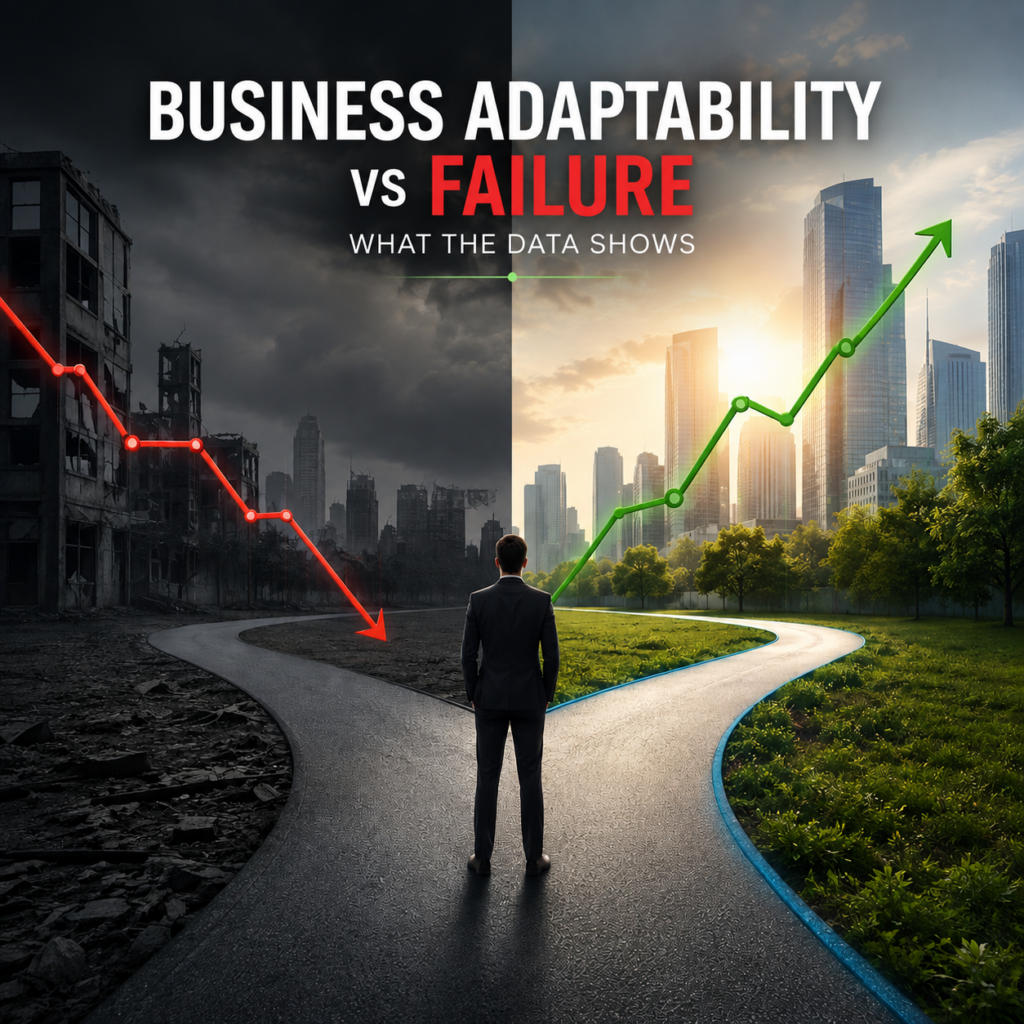
Business Adaptability vs Failure: What the Data Shows

Every industry has its version of the company that saw the shift coming and the one that didn’t, sitting side by side until only one of them was still around. Business adaptability vs failure isn’t a matter of luck or timing as much as it looks like from the outside. Recent research has gotten specific about what actually separates the two outcomes, and the gap has less to do with resources than most struggling companies assume. The Data Behind Business Adaptability vs Failure The scale of this churn is larger than most people realise. Innosight’s corporate longevity research found the average tenure of a company on the S&P 500 has fallen from 33 years in 1965 to roughly 15 years as of 2026, with the firm’s churn-rate forecast suggesting close to half of today’s S&P 500 companies will be replaced within the next decade. That’s not a story about small businesses struggling to compete; it’s a pattern showing up among companies that were, at some point, large and dominant enough to be included in the index at all. Size and past success have stopped being reliable protection against being left behind. Why Most Transformation Efforts Fail Anyway It would be reasonable to assume large companies are at least trying to adapt, and mostly they are, but the attempt itself doesn’t guarantee the outcome. A Boston Consulting Group study of more than 850 companies found digital transformation projects achieve only a 35 per cent success rate globally, and Gartner has separately predicted that by 2027, 80 per cent of data and analytics governance initiatives will fail outright. Business adaptability vs failure isn’t decided by whether a company launches a transformation program. Most of them do. It’s decided by whether that program actually changes how decisions get made, and the data above suggests that’s the part most initiatives never reach. Digitalisation Helps, But Only as a Multiplier New technology gets treated as the obvious answer to this problem, and the research does support that direction, with an important caveat attached. A 2025 study of Chinese enterprise survey data found that firms with greater digitalization exhibited significantly greater organizational agility during crises, allowing them to adapt their business models faster, and a separate study of Chinese A-share listed firms from 2007 to 2023 found digital transformation strengthens organizational resilience specifically by improving innovation capability and agile response, with the effect notably stronger in capital-intensive industries and among firms already at a growth or maturity stage. That last detail matters: digitalisation amplified agility that was already developing inside a company’s operating model. It didn’t manufacture agility on its own inside a company that had none to begin with. What Actually Separates the Businesses That Adapt Industry research on business agility points to a specific mechanism rather than a general trait. Organisations that adapt well tend to have clarity about how authority and decisions are actually allocated, so that when conditions shift, people closer to the problem can act without waiting for a decision to travel up and back down a hierarchy. Under pressure, poorly adapted organisations tend to do the opposite: governance slows further, silos harden, and leadership retreats into tighter control at exactly the moment faster, more distributed decisions are needed. The businesses that get left behind aren’t usually the ones facing the biggest disruption. They’re the ones whose decision-making gets slower precisely when the environment demands it get faster. A Historical Pattern That Keeps Repeating The specific companies that drop off the S&P 500 in any given decade change, but the underlying pattern behind why they drop off has stayed remarkably consistent across research spanning several decades now. Innosight’s longitudinal tracking shows the same churn dynamic playing out across retail, financial services, energy, and technology at different points, with each wave of disruption catching a similar share of otherwise well-resourced incumbents off guard. What tends to distinguish the companies that survive a given wave of disruption from the ones that don’t isn’t whether they saw the change coming; most large companies employ people whose job is specifically to track exactly that. It’s whether the organisation was structurally capable of acting on that early warning before a smaller, faster competitor made the same insight commercially real first. Psychological Safety Is Part of the Mechanism, Not a Soft Extra A 2026 industry survey on business agility skills identified something easy to dismiss as a soft, secondary factor: psychological safety- environments where failure is treated as a learning step rather than a career risk- alongside genuine customer-centricity built on fast feedback loops and adaptive governance structures built to flex rather than hold a fixed plan. These aren’t abstractions. An employee who’s afraid to flag that a strategy isn’t working, or a manager who suppresses bad news rather than escalating it quickly, is functionally the same failure mode as the slow governance described above, just happening at an individual level instead of a structural one. Business adaptability vs failure often comes down to whether bad news travels through an organisation quickly enough to be acted on, or gets quietly absorbed until it’s too late to matter. Employee-Level Agility Is the Foundation Most Strategies Skip A 2026 academic review tracing 25 years of research on this topic makes a point that’s easy to miss in strategy documents written at the leadership level: organisational agility has an individual-level foundation, employee agility, that has received far less attention than the organisation-wide capability it’s supposed to produce. A company can redesign its org chart, flatten its reporting lines, and invest heavily in new tools, but if the people actually closest to a shifting market don’t have the specific skills, confidence, or authority to act on what they’re seeing, the structural changes accomplish very little. This is part of why business adaptability vs failure often looks, from the outside, like a strategy or leadership failure, when the actual gap sits several layers below the strategy document, in whether individual employees are actually equipped and empowered to notice and respond to

Blog

Skills vs Salary Early Career: What 2026 Data Shows

Two job offers: one pays a bit more, the other promises real mentorship and a faster skill curve, and the instinct for most new graduates is to take the money. Skills vs salary early career decisions feel like they should be simple math, but 2026 labour market data suggests the higher number on the offer letter is often the weaker long-term choice, for reasons that show up clearly once the first few years actually play out. The Wage Scarring Research Behind This Question The starting conditions for the class of 2026 make this decision higher stakes than usual. Recent graduates faced a 5.6 per cent unemployment rate in early 2026, nearly double the 2019 level, and economists have documented a well-established pattern called wage scarring, where graduates entering a weak labour market earn measurably less than peers who started in a stronger one, for up to a decade afterwards. The mechanism behind that scarring, identified in research by economist Till von Wachter, is specific: the effect lifts fastest for workers who move from the smaller, lower-paying firms they often land in during a weak market toward better employers once conditions improve. That single detail reframes the skills vs salary early career question entirely, since it means the first job’s main value isn’t the paycheck it delivers today; it’s the platform it gives someone to move from later. Why Skills Beat a Few Thousand Dollars of Starting Pay Career guidance built around this exact scarring research lands on a specific recommendation: take the job that builds skills, even over a slightly higher starting salary, since mentorship and genuine learning early in a career tend to matter more than a modest gap in year-one pay. The logic follows directly from the von Wachter mechanism above. A role with weak mentorship and limited skill growth, even at a higher starting salary, tends to trap someone in that smaller, lower-paying tier of employer the scarring research describes, while a role that builds real capability creates exactly the credential needed to move to a better employer at the moment the scarring effect is supposed to lift. The Job-Switching Premium That Erases a Cautious Start This is where the math becomes measurable rather than just directional. The Atlanta Fed’s Wage Growth Tracker showed job switchers earning 5.0 per cent annual wage growth in March 2026, compared to 3.8 per cent for people who stayed in their current role, a gap that compounds with every subsequent move. Career researchers tracking this pattern have found that a well-timed move at the 18- to 30-month mark is often the single largest raise of an early career, larger than what waiting for an internal promotion typically delivers. A modest starting salary at a skill-building role, followed by a well-timed switch once real capability has been built, consistently outperforms a higher starting salary at a role that never provides the skills needed to make that first switch worthwhile. Which Specific Skills Are Actually Worth Prioritising Not every skill carries the same weight in this decision, and treating skill-building as a vague, generic goal misses where the real leverage sits. Industry analysis of 2026 hiring data points to a specific combination rather than any single speciality: stacking one technical skill, one analytical skill, and one execution skill, such as a specific software tool paired with data analysis and stakeholder management, tends to be more marketable than deep expertise in one narrow area alone. AI workflow fluency in particular has moved from a differentiator to what recruiters increasingly describe as a baseline expectation across industries, according to the 2026 12twenty Jobs Report, which also found that internships remain one of the strongest predictors of early-career outcomes, since employers increasingly use them as extended, low-risk assessments before converting a candidate into a full skill-building role. Where Salary Negotiation Actually Does Matter None of this means the number on an offer letter is irrelevant, and there’s one place where salary itself deserves direct, immediate attention: whatever offer is actually on the table should be negotiated rather than accepted as written. Research from Carnegie Mellon University found that candidates who negotiated their starting salary increased compensation by an average of 7.4 per cent, a gap that compounds into an estimated 320,000 dollars or more in additional lifetime earnings, and roughly 58 per cent of job seekers accept the first offer without attempting to negotiate at all. Skills vs salary early career isn’t really an argument against negotiating pay. It’s an argument for negotiating hard on whichever offer builds the strongest skill trajectory, rather than simply chasing the highest number between two otherwise different roles. Starting Salary Isn’t the Same as Lifetime Earnings Data comparing entry-level pay against career trajectory backs up the skill-first instinct directly. Georgetown’s Centre on Education and the Workforce data shows most college majors see salary growth of 50 to 150 per cent between the starting role and mid-career, and industry researchers analysing 2026 starting salary data note explicitly that the career with the highest starting salary is not always the one with the highest lifetime earnings. A role that looks unremarkable on a first offer letter but sits inside a field or a company with strong internal growth and skill development can outperform a higher-paying but flatter role within a few years, well before the ten-year scarring window described above has even closed. When the Higher-Paying Offer Is Actually the Right Call This isn’t a universal rule that skill-building always wins regardless of circumstance, and treating it that way would be its own mistake. Someone carrying significant student debt, supporting family financially, or facing genuine housing or cost-of-living pressure has real, immediate constraints that a theoretically better long-term trajectory doesn’t resolve on its own. In those situations, a higher-paying offer that covers real obligations today can be the financially responsible choice even if it offers a flatter skill curve, and the honest version of this advice accounts for that rather than assuming everyone is choosing between two offers from a position

Blog

Why Communication Beats a Better Idea, Backed by Data

It’s a familiar sting in a meeting room: a proposal gets a lukewarm reception, and weeks later a nearly identical version, presented more confidently by someone else, gets funded, approved, or praised. Why communication beats a better idea isn’t just an office grievance. It’s now been measured directly in peer-reviewed research, and the findings are more uncomfortable than the usual advice to just speak up more. The Investor Study That Proves This Directly The clearest evidence comes from a 2025 Journal of Finance study that used machine learning to analyse full video recordings of startup pitches, measuring persuasion across visual, vocal, and verbal delivery separately from the substance of the pitch itself. The researchers found that positive, passionate, warm pitch delivery meaningfully increased the probability of getting funded, and a controlled experiment confirmed the mechanism directly: persuasive delivery worked mainly by leading investors to form inaccurate beliefs about the venture, not by more accurately conveying the venture’s actual quality. In plain terms, the researchers found that better delivery didn’t just help investors see a good idea more clearly. It changed what investors believed was true about the idea, independent of whether it actually was. The Uncomfortable Twist: Better Delivery Can Predict Worse Outcomes This is where the finding stops being simply flattering to good communicators and becomes a genuine caution. The same study found that conditional on getting funded, startups with higher levels of pitch positivity actually underperformed afterwards, meaning the delivery that won the money was systematically disconnected from the delivery that would have predicted real success. Why communication beats a better idea in the moment of the pitch is precisely why it can produce worse decisions downstream: the people making the call were responding to confidence and warmth, not to the underlying merit the pitch was supposed to represent. The study also found a gender pattern worth noting: women were judged more heavily on delivery when pitching in single-gender teams, but their delivery contribution was effectively neglected when co-pitching in mixed-gender teams, showing the bias isn’t applied evenly even within the same dynamic. The Same Pattern Repeats Inside Companies, Not Just Pitch Rooms This isn’t unique to investor pitches. A 2026 University of Toronto study spanning more than 1,600 participants across two experiments found that employees whose ideas are taken or misattributed by someone else experience a genuine loss of ownership, recognition, and opportunity, a pattern strongly enough established that it now sits in the organisational psychology literature as a distinct, documented category of workplace harm. The mechanism is often mundane rather than malicious: the person who repeated an idea more clearly, more confidently, or at a more visible moment in a meeting is remembered as the source, regardless of who actually generated it first. Why Assertive Communication Gets Read So Differently Part of why this dynamic feels so unfair in the moment is that the same communication behaviour gets interpreted in sharply different ways depending on who’s doing it. Research on workplace communication styles has found that assertive behaviour- direct, clear, willing to hold a position- is consistently misread as aggressive or difficult when it comes from women, members of underrepresented groups, or younger employees, even when the actual content and tone match what’s praised as confident leadership when it comes from someone else. This means the fix isn’t just to build confidence and speak up, since the same clarity that reliably earns credit for one person can be penalised for another. Recognising that gap is part of what a fair evaluation process, whether it’s a pitch panel or a team meeting, actually has to correct for, rather than assuming the playing field for delivery is level to begin with. Why This Isn’t Really an Argument for Manipulation It would be easy to read the investor study as a playbook for performing confidence regardless of substance, but that reading misses the actual lesson. The research shows persuasive delivery creates inaccurate beliefs, which is a real risk to the listener, not a feature to exploit responsibly. The more durable, honest version of why communication beats a better idea isn’t about performing warmth over substance; it’s about the fact that an idea nobody can follow, however good, functions identically to an idea that doesn’t exist yet in the mind of whoever needs to approve or fund it. Clarity isn’t manipulation. It’s the difference between an idea that exists only in its creator’s head and one that exists in the room. Why the Written Version of an Idea Matters Just as Much Pitch delivery gets most of the research attention, but a large share of ideas are first evaluated on paper, in an email, a one-page summary, or a written proposal, long before anyone speaks them aloud. Research on executive summaries specifically has found that the way an idea is framed in that first written document meaningfully shapes whether it gets a second look at all, independent of the underlying opportunity described. An idea buried in the fifth paragraph of a dense memo competes at a real disadvantage against a weaker idea stated plainly in the first sentence, for the same reason a mumbled pitch loses to a confident one: the evaluator’s attention and working memory are limited resources, and whichever version of the idea is easiest to hold in mind ends up carrying more weight in the decision, whether that’s fair to the underlying substance or not. This means the fix described throughout this piece applies just as much to how something is written as to how it’s spoken. What Actually Makes an Idea Explained Well The research points toward a specific, learnable difference between communication that manipulates and communication that genuinely clarifies. Structuring a pitch or proposal around what the specific audience needs to decide, rather than everything the presenter finds interesting about the idea, respects the actual decision being made instead of performing enthusiasm at it. Leading with the strongest, most defensible piece of evidence rather than saving it for the end gives a sceptical listener

Blog

How to Use AI Without Being an Expert in 2026

Most people who feel behind on AI picture the wrong bar. They imagine needing to understand neural networks or write machine learning code to stay relevant, when the actual, measurable demand from employers in 2026 is something far more achievable. How to use AI without being an expert turns out to be exactly what most organisations are hiring and training for right now, not the deep technical fluency the word AI tends to conjure. What Employers Actually Mean by AI Skills The gap between the perceived bar and the actual bar is large, and it’s backed by direct research. The OECD estimates that fewer than 1 per cent of workers will need advanced technical capabilities such as AI programming or model development, with most workers instead needing general digital proficiency, occupational knowledge, and the judgment to apply AI appropriately within their existing role. That distinction, between building AI and knowing how to use it well, is exactly where the actual hiring demand sits, and it’s a distinction most job seekers and employees haven’t fully internalised yet. The Data Behind This Shift The speed at which this expectation has spread is easy to underestimate. NACE reported in April 2026 that more than one-third of entry-level positions now require AI skills, nearly three times the share reported just six months earlier in fall 2025, and almost 60 per cent of employers were already assigning interns projects involving AI tools. This demand isn’t concentrated in tech roles either. Labour market analytics firm Lightcast found that 51 per cent of AI-related job postings in 2026 sit outside traditional IT roles entirely, spread across marketing, operations, HR, finance, and customer support. How to use AI without being an expert has effectively become a baseline expectation across nearly every occupation, not a specialised skill reserved for technical teams. Why Practical Fluency Beats Technical Depth for Most Roles A 2026 survey run by DataCamp and YouGov across more than 500 enterprise leaders in the US and UK found something worth sitting with: nearly two in three leaders report a data or AI skills gap inside their organization, but the researchers concluded the real problem is foundational AI literacy, not specialized development skills, meaning most organizations already have the tools, they lack people who can apply them competently. The same report found organisations with a mature, organisation-wide AI literacy program were nearly twice as likely to report significant AI return on investment, with 42 per cent reporting strong ROI compared to a much smaller share among organisations without structured upskilling. Buying the tool was never the hard part. Teaching people to use it well was. What Knowing How to Use AI Actually Means Day to Day Stripped of the more abstract framing, this practical fluency comes down to a specific, learnable set of habits rather than a technical credential. It means understanding what a given AI tool is actually good at and where it tends to fail, recognising when an output sounds confident but is factually wrong, writing a prompt clearly enough that the first response is usable rather than needing five rounds of correction, and knowing when a task genuinely needs human judgment rather than being handed off wholesale. None of this requires understanding how a language model is trained. It requires the same kind of applied competence someone develops with any new piece of workplace software, just with a slightly higher premium on scepticism toward the output. Prompting Alone Isn’t the Skill Either It’s worth being precise about what practical AI fluency isn’t, since a common misconception has replaced one overblown bar with another. Writing a good prompt is a small, learnable mechanical skill, not the core competency employers are actually screening for. Industry analysis of 2026 hiring criteria makes this point directly: prompting without judgment is easily replaceable, since a clever prompt that produces a wrong or misleading answer is still a wrong answer, just delivered more efficiently. What employers are actually testing for, whether explicitly in an interview or implicitly through how someone performs on the job, is the judgment layered on top of the prompt: knowing when to push back on an AI’s answer, when to verify it against another source, and when to discard it entirely and do the task manually because the tool isn’t suited to it. That judgment is the actual skill. The prompt is just the interface. Why This Skill Gap Has Real Consequences This isn’t an abstract concern about falling behind eventually. The World Economic Forum reported in March 2026 that entry-level roles in the US had declined by 35 per cent, a shift partly attributed to automation absorbing tasks that used to make up junior positions. The uncomfortable implication isn’t that AI is replacing people wholesale; it’s that the traditional entry point into many careers, a role built mostly around routine execution, is shrinking, which makes the ability to work alongside AI effectively less of a nice-to-have and more of a genuine prerequisite for competing for the roles that remain. This Applies Well Beyond Entry-Level Roles It’s tempting to read the entry-level statistics above as a problem specific to people early in their careers, but the same expectation is showing up at senior levels too, just framed differently. A manager or executive doesn’t need to prompt an AI tool personally to feel this shift; they need to know enough to evaluate whether a team’s AI-assisted output is trustworthy, to ask the right questions when a report or forecast was AI-generated, and to set reasonable expectations for what AI can and can’t reliably handle inside their function. Industry coverage of 2026 hiring trends consistently frames this as oversight and decision-making rather than hands-on tool use: senior professionals who understand AI’s practical limits make better calls about where to deploy it and where to keep a human fully in the loop, which is its own form of the same fluency described above, just applied at a different altitude in the organisation. How to Actually Build This Fluency The

Blog

The Real Export Process From Inquiry to Shipment

An inquiry from a buyer overseas feels like the finish line after months of outreach, but it’s actually the starting gun. The real export process from inquiry to shipment runs through several distinct stages, each with its own paperwork, its own deadline, and its own way of quietly going wrong if skipped or rushed, and most of the actual work happens well after the buyer has already said yes. Step 1: The Inquiry Becomes a Quotation A buyer’s inquiry is rarely a finished specification. It’s usually a starting point that needs clarifying: exact quantity, packaging requirements, quality standards, and delivery timeline all need to be pinned down before a quotation means anything. A quotation sent too early, based on assumptions rather than confirmed specifications, tends to need revision later, and every revision at this stage costs less time than the same correction discovered after production has already started. Getting the Incoterm right at the quotation stage matters more than it seems: quoting FOB versus CIF changes who’s responsible for freight, insurance, and a meaningful share of downstream risk, and that decision should be made deliberately rather than defaulted to whatever the buyer first suggests. Step 2: The Proforma Invoice Locks In the Deal Once the buyer confirms interest at the quoted price, the next document is the proforma invoice, not the final commercial invoice. A proforma invoice is a non-binding, preliminary document that outlines estimated costs, product details, and terms, distinct from a commercial invoice in that it carries no legal weight and isn’t used for accounting or tax purposes, but it plays a genuinely functional role: buyers use it to arrange financing, apply for import permits, or open a letter of credit before the actual transaction happens. For Indian exporters specifically, issuing a proforma invoice isn’t a legal requirement, but it’s become close to universal practice, since it gives both sides a written reference point before money or goods actually move. Step 3: Getting the Payment Terms Structured Correctly How payment is structured at this stage determines how much risk the exporter is actually carrying for the rest of the transaction. Advance payment protects the exporter fully but is often unrealistic for a first-time buyer relationship. A letter of credit shifts payment risk to the buyer’s bank rather than the buyer directly, at the cost of tighter documentary compliance, since a bank will refuse payment over a minor mismatch between the LC terms and the shipping documents. Documents against payment or documents against acceptance sit in between, giving the buyer some flexibility while still requiring bank involvement to release the shipping documents. Open account terms, common with established buyer relationships, put the most risk on the exporter, since goods ship before payment is received at all. None of these terms is automatically correct. The right choice depends on how much the exporter can afford to be wrong about a new buyer’s reliability. The Registrations That Need to Already Exist Before Step One Everything described above assumes a set of registrations are already in place, and skipping this groundwork is one of the most common reasons a first export deal stalls after the buyer has already agreed to terms. An Importer Exporter Code from DGFT is mandatory before any commercial export can happen at all, regardless of the shipment’s size, and it needs an annual profile update between April and June, or it gets deactivated. A GST LUT filed at the start of the financial year allows goods to ship without IGST paid upfront, avoiding a working capital delay that catches new exporters off guard on their very first shipment. And an AD Code registered with the bank at the specific port being used, not just registered generically, needs to be sorted before freight booking becomes possible. None of this needs to happen the day an inquiry arrives, but it does need to happen before the proforma invoice becomes a real order, since discovering a missing registration after production has already started is far more expensive than sorting it out at the beginning. Step 4: Production and Pre-Shipment Compliance With terms agreed, production begins, and this is where compliance work needs to happen in parallel rather than after the goods are ready. Confirming the correct HS or HSN classification before production finishes, rather than after, avoids a last-minute scramble that can delay the entire shipment. Food products need FSSAI clearance sorted before packaging is finalised, and every packaged product needs Legal Metrology-compliant labelling, country of origin, net quantity, MRP, and manufacturer details, printed correctly the first time rather than corrected after a batch is already sealed. A pre-shipment inspection, either self-conducted or through a third party the buyer specifies, catches quality issues while there’s still time to fix them, which is considerably cheaper than a rejected shipment or a post-delivery dispute over a defect discovered on the buyer’s end. Step 5: Booking Freight and Watching the Cut-Off Clock Once goods are ready, freight booking introduces a new, tighter set of deadlines. A container has to clear several separate cut-offs, shipping instructions, verified gross mass, and physical arrival at the container yard, all before the vessel’s actual departure, and missing any single one of them gets the shipment rolled to the next available sailing, typically a delay of a week or more. This stage is where the paperwork prepared in step four actually gets tested: a shipping bill filed with an inaccurate HS code, or a container that arrives at port without its VGM submitted, doesn’t just risk a delay; it can block the shipment from loading entirely regardless of how ready everything else is. Step 6: Customs Clearance and the Paper Trail Customs clearance runs on a specific document set: the commercial invoice, packing list, shipping bill, and certificate of origin all need to match each other exactly, since a mismatch between any two of them is one of the most common reasons a shipment gets flagged for physical examination rather than cleared automatically. The shipping bill itself gets

Blog

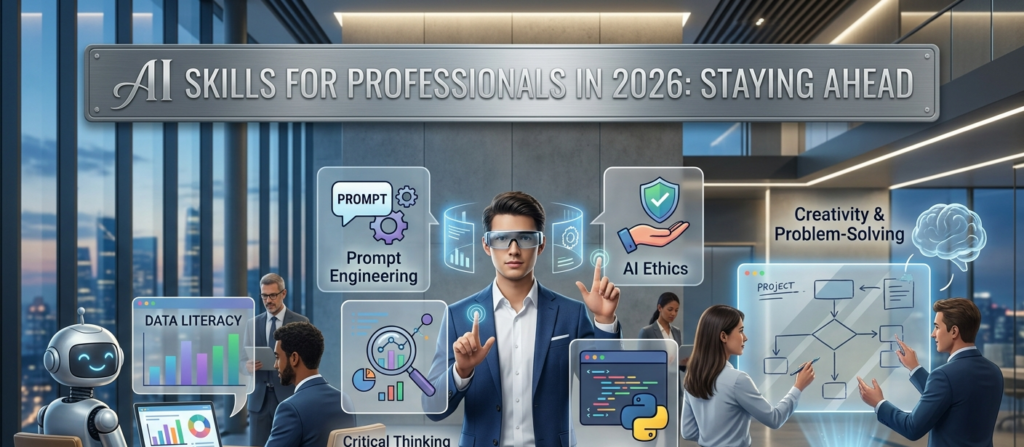
AI Skills Every Student Should Learn

Artificial Intelligence is no longer something limited to tech companies, scientists, or software engineers. From the apps we use every day to the tools helping businesses make decisions, AI has become a part of modern life. For students, learning how to work with AI can be a major advantage when preparing for higher education and future careers. The good news is that students don’t need to become AI researchers to benefit from this technology. Developing a few practical AI skills can help students study smarter, solve problems faster, improve creativity, and become more competitive in the job market. So, what AI skills should students focus on? Let’s explore the most useful ones. 1. AI Literacy and Basic Understanding The first AI skill every student should develop is AI literacy. You don’t need to understand complicated algorithms or advanced mathematics at the beginning. Instead, learn what AI is, how it works at a basic level, where it is used, and what its limitations are. Understanding concepts such as machine learning, generative AI, chatbots, automation, and large language models can help students use AI tools more confidently. AI literacy also teaches students an important lesson: AI is a tool, not a replacement for human thinking. 2. Prompt Engineering One of the most practical skills students can learn today is prompt engineering. AI tools are only as useful as the instructions you give them. A vague prompt may produce a generic answer, while a clear and detailed prompt can generate much more useful results. Students should learn how to: For example, instead of asking an AI tool to “explain marketing,” a student could ask it to explain digital marketing in simple language with real-world examples for a beginner. This simple difference can dramatically improve the quality of AI-generated responses. 3. Critical Thinking and Fact-Checking AI can provide information quickly, but that doesn’t mean everything it generates is correct. This is why critical thinking is one of the most important AI skills for students. Students should learn to question AI-generated information, verify facts, compare different sources, and identify potentially misleading content. When using AI for assignments or research, students should not simply copy and paste the output. Instead, they should understand the information, check reliable sources, and add their own perspective. Learning to work with AI while maintaining independent judgment is a skill that will remain valuable regardless of how AI technology evolves. 4. Data Literacy AI depends heavily on data. Because of this, having a basic understanding of data can be extremely useful. Students should learn how to read charts, understand percentages, identify patterns, and interpret basic datasets. Familiarity with spreadsheets and basic data analysis can also be helpful. Data literacy allows students to understand how information is collected, organised, and used to make decisions. Whether someone wants to work in business, marketing, finance, healthcare, technology, or research, the ability to understand data can become a valuable career skill. 5. AI-Powered Productivity Students can use AI to improve everyday productivity when they use it responsibly. AI tools can help with brainstorming, summarising notes, creating study plans, organising ideas, generating practice questions, and improving written communication. For example, a student preparing for an exam could use AI to create a revision schedule based on different subjects and available study hours. The goal isn’t to let AI do all the work. Instead, students should use AI to reduce repetitive tasks and spend more time on learning, creativity, and problem-solving. 6. Basic Coding and Automation Coding is another valuable skill to combine with AI. Students don’t necessarily need to become professional programmers, but learning basic programming concepts can help them understand how technology works and build simple AI-powered projects. Languages such as Python are commonly used in AI and data-related fields. Beginners can start with fundamentals such as variables, conditions, loops, functions, and basic data handling. Understanding automation can also help students discover ways to make repetitive digital tasks more efficient. 7. AI Ethics and Responsible Use With great technology comes great responsibility. Students should understand the ethical side of artificial intelligence, including privacy, bias, copyright, misinformation, and responsible use of AI-generated content. For instance, using AI to brainstorm ideas can be helpful, but submitting completely AI-generated academic work without understanding it can create ethical and academic problems. Learning responsible AI usage helps students become not just skilled users but thoughtful digital citizens. 8. Creativity and Problem-Solving with AI AI becomes even more powerful when combined with human creativity. Students can use AI to brainstorm business ideas, develop presentations, create content concepts, explore design ideas, and approach problems from different perspectives. However, the most valuable results usually come when students bring their own ideas and experiences into the process. AI can generate possibilities, but students still need to decide which ideas are meaningful, practical, and original. Why AI Skills Matter for Students The job market is changing rapidly, and employers increasingly value people who can adapt to new technologies. Students who develop AI skills early can gain confidence in using modern tools and become better prepared for future opportunities. More importantly, AI knowledge can complement traditional skills such as communication, creativity, teamwork, research, and problem-solving. Institutions such as CSB can help learners build practical technology skills through structured learning, projects, and industry-relevant training. The future isn’t necessarily about choosing between humans and AI. It is about learning how humans can use AI effectively. Final Thoughts AI is becoming an important part of education, business, and everyday life. For students, the best time to start learning AI skills is now. From AI literacy and prompt engineering to data understanding, coding, critical thinking, and ethical AI use, these skills can help students become more confident and future-ready. CSB focuses on helping learners practically understand modern digital skills, making technology easier to approach for students from different backgrounds. Remember, you don’t have to learn everything about AI in one day. Start with the basics, experiment with AI tools, build small projects, and keep learning. The students who learn

Scroll to Top