

Blog

Your blog category

Blog

How to Validate a Business Idea Before Spending Any Money

Most failed businesses don’t fail because the product was badly made; they fail because no one checked whether enough people actually wanted it before serious money went into building it. Validate a business idea is a phrase that gets used loosely, often reduced to asking friends and family for feedback, when real validation means something much more specific: getting evidence from strangers that they’ll actually act, not just comment, before a single rupee goes into inventory, development, or a storefront. Why Asking People If They Like an Idea Doesn’t Count The most common validation mistake is treating positive feedback as proof of demand, when the two have almost nothing to do with each other. Lean startup research draws a sharp line between stated interest and revealed preference- what someone says they’d do versus what they actually do when asked to commit something– and found that the gap between the two is often enormous. A friend saying “I’d definitely buy that” costs them nothing and predicts almost nothing, while someone handing over a deposit, pre-ordering, or giving up real time for a pilot is the only kind of response that reliably signals genuine demand. Why the First Step Is Defining What Would Actually Change Your Mind Before testing anything, it’s worth deciding in advance what result would mean the idea doesn’t work, since without that line drawn beforehand it’s tempting to interpret almost any result as encouraging. Entrepreneurship research on hypothesis testing recommends writing down a specific, falsifiable prediction before collecting any data, such as a target conversion rate or number of commitments, rather than gathering feedback first and deciding afterwards whether it counts as a good sign. A founder who skips this step is prone to reading enthusiasm into ambiguous results simply because they already want the idea to work. Why a Landing Page Is Often the Fastest First Test One of the lowest-cost ways to test demand is building a single page describing the product or service exactly as it would be sold, then driving a small amount of traffic to it and measuring what visitors actually do. Startup validation research consistently points to a landing page with a real call to action, a waitlist signup, a deposit, a pre-order, as one of the most efficient ways to gauge genuine interest before any product exists. The page doesn’t need to be polished. It needs to accurately represent the offer and give visitors something concrete to say yes to, since a vague description collecting vague interest teaches very little. Why Talking to Strangers Beats Talking to Your Network Friends, family, and existing colleagues are structurally bad validation sources, not because they’re dishonest, but because they have a social incentive to be encouraging regardless of what they actually think. Customer discovery research emphasises seeking feedback from people with no personal relationship to the founder, since they have nothing to lose by being honest and no reason to soften a negative reaction. Strangers in a target market, found through online communities, cold outreach, or existing customer bases of adjacent products, give a far more reliable read on whether an idea has real appeal outside a founder’s immediate circle of goodwill. Why a Concierge Test Reveals More Than a Survey Ever Will Surveys are useful for gathering opinions, but they rarely predict whether someone will actually pay for or use a product. A more revealing approach is manually delivering the core value of the idea to a handful of real customers before building anything automated or scalable. Lean methodology describes this as a concierge test, doing the service by hand for a small number of paying customers to learn what the business actually requires before investing in infrastructure. A founder who manually fulfils the first ten orders learns more about real operational friction and actual willingness to pay than any amount of survey data could reveal. Why Pricing Has to Be Part of the Test, Not an Afterthought A common validation mistake is testing interest in a product without ever mentioning a real price, which produces a misleadingly high signal of demand. Pricing research on early-stage products shows that willingness to engage drops substantially once a real price is introduced, and that drop is itself valuable information about whether the idea has commercial viability at a sustainable price point. Testing demand at zero cost, free samples, free trials with no eventual payment, tells a founder almost nothing about whether a real business exists underneath the interest. Why Small Sample Sizes Are Fine as Long as the Signal Is Real Founders often delay validation because they assume a meaningful test requires hundreds of responses, when a small but genuine signal is usually more useful than a larger but weak one. Early-stage validation guidance suggests that ten to twenty people taking a real, costly action is a stronger signal than a hundred people giving a vague opinion, since the quality of the signal matters far more than its volume at this stage. A handful of strangers paying a deposit for a product that doesn’t exist yet is more convincing evidence than a survey of a hundred people who merely clicked a button marked “interested.” Why a Negative Result Is Still a Useful Outcome A test that shows weak demand often feels like a failure, but treating it that way misses the actual point of validating in the first place. Entrepreneurship research on early-stage failure describes a validated “no” as far cheaper and more valuable than an unvalidated failure discovered after months of building, since a cheap test that rules out a weak idea frees up time and money for a better one, while a product built on an untested assumption often fails only after the cost of building it is already sunk. Reframing a disappointing test result as useful information rather than wasted effort is part of what separates founders who iterate efficiently from those who keep rebuilding the same flawed idea with a different coat of paint. Why Validation Is a Process, Not
Blog

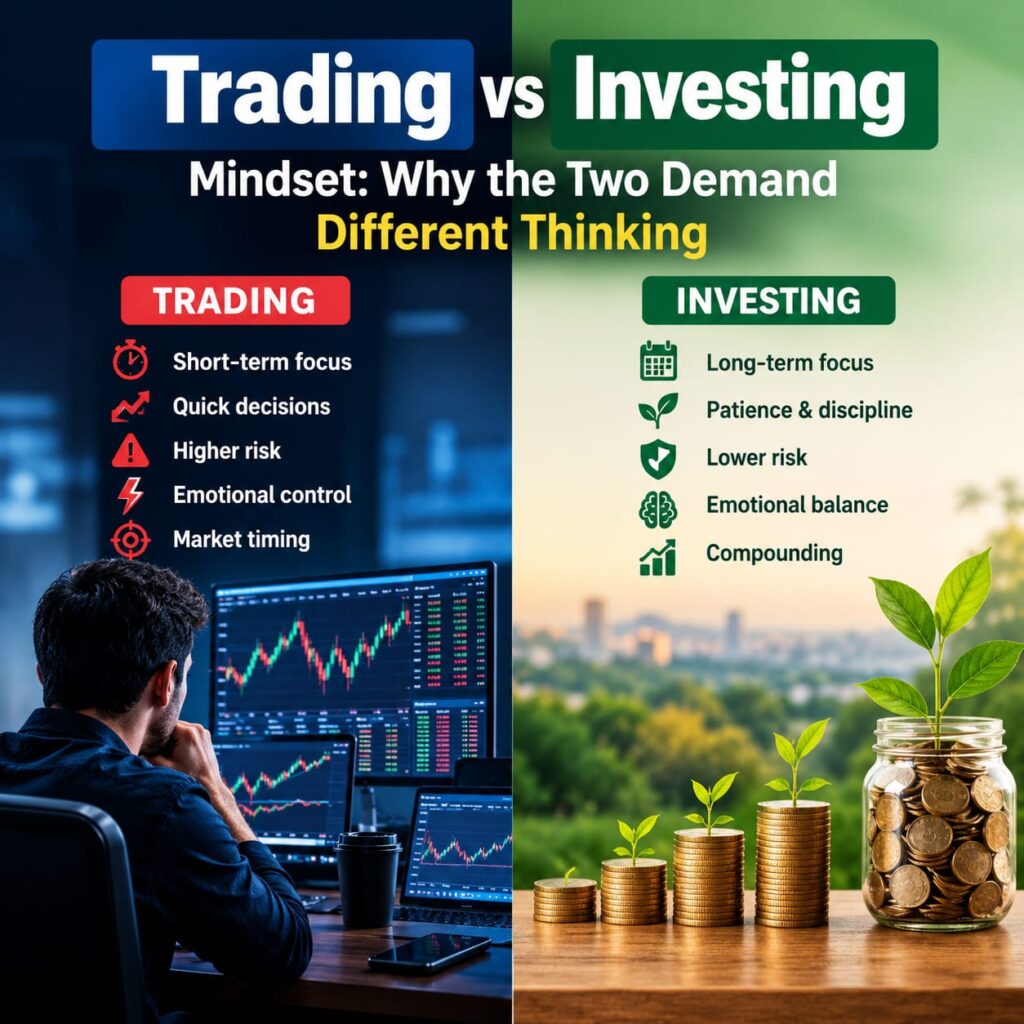
Trading vs Investing Mindset: Why the Two Demand Different Thinking

Trading and investing are often treated as two points on the same spectrum, just different time horizons applied to the same basic activity of buying and selling securities. Trading vs investing mindset differences suggest something more fundamental is actually going on, since the psychological skills that make someone effective at one approach frequently work against them in the other. Time horizon is really just the visible symptom of a much bigger difference in how each approach requires a person to think. Why Time Horizon Isn’t the Real Divide The textbook distinction between trading and investing usually comes down to holding period, days or weeks for trading, years for investing, but that framing undersells what’s actually different between them. Behavioural finance research describes the deeper split as a difference in what each approach treats as the primary source of return, short-term price movement versus long-term business or asset value, which means the two require evaluating completely different kinds of information and tolerating completely different kinds of uncertainty, regardless of how long a specific position happens to be held. Why Traders Need Comfort With Constant Decision-Making A trader is making frequent, time-pressured decisions, and the mental demands of that environment are considerably different from a decision made once and revisited occasionally. Research on trading psychology finds that successful traders tend to show high tolerance for rapid, repeated decision-making under incomplete information, a trait that lets them act decisively on a setup without the extended deliberation an investor might apply to a single decision. This same trait can work against an investor, since acting quickly on incomplete information is often exactly the wrong instinct when the goal is patient, long-term ownership rather than reacting to a short-term price move. Why Investors Need Comfort With Not Acting Where trading rewards decisive action, investing frequently rewards the opposite, specifically, the discipline to do nothing while a position fluctuates in ways that feel uncomfortable. Behavioural research on long-term investor outcomes finds that the single strongest predictor of investor underperformance is excessive trading activity driven by short-term price movements, meaning investors who intervene the most frequently tend to produce worse long-term results than those who intervene the least. This makes patience itself a core skill for investing in a way it simply isn’t for trading, where inaction often means a missed opportunity rather than a disciplined choice. Why Loss Tolerance Works Differently in Each Approach Both trading and investing involve losses, but the psychological relationship to those losses differs sharply between the two. Trading psychology research emphasises quick, unemotional acceptance of a small loss as a defining skill of successful traders, since a trader who hesitates to exit a losing position quickly often turns a small, manageable loss into a much larger one. Investors operate under a different logic entirely, where a temporary decline in a fundamentally sound asset is often something to tolerate or even add to rather than exit from, which means the instinct to cut losses quickly, so valuable in trading, can actively undermine a long-term investing strategy if applied in the wrong context. Why Information Processing Demands Differ So Much The kind of information each approach relies on shapes a meaningfully different cognitive skill set. Traders typically focus on short-term price patterns, volume, and market sentiment, information that changes by the minute and requires fast pattern recognition under pressure. Investors are more often evaluating business fundamentals, competitive position, and long-term growth prospects, information that changes slowly and rewards careful, unhurried analysis. Someone skilled at rapidly reading a price chart isn’t automatically equipped to evaluate a company’s five-year competitive position, and the reverse is just as true. Why Emotional Regulation Looks Different in Practice Both approaches require managing emotion, but the specific emotional challenge each one presents is distinct. Trading psychology research points to managing the intensity of frequent wins and losses within short timeframes as the core emotional challenge for traders, since the sheer frequency of outcomes creates a constant stream of emotional triggers to regulate. Investors face a quieter but arguably harder version of the same challenge: sustaining conviction through long stretches of uneventful or even declining performance, without the frequent feedback that either confirms or challenges the original decision. Why Mixing the Two Mindsets Often Backfires A common and costly mistake is applying a trading mindset to an investing position, or an investing mindset to a trade, which research on retail investor behaviour identifies as a recurring source of poor outcomes. Checking a long-term investment’s price daily and reacting to short-term noise applies a trading-frequency mindset to a position that was supposed to be evaluated on a much longer timescale, often leading to an early exit from a sound long-term position based on short-term volatility that was never actually relevant to the original thesis. The reverse mistake, holding a losing trade out of long-term conviction when the original trade setup was specifically short-term, tends to turn a small planned loss into a much larger unplanned one. Why Risk Management Means Something Different in Each Approach Risk management is central to both trading and investing, but the mechanics look almost nothing alike between the two. Trading risk management research emphasises defining an exact exit point before entering a position and sizing each trade so a single loss stays small relative to total capital, a mechanical, pre-planned approach suited to frequent, fast decisions. Investment risk management instead centres on diversification across assets and sectors, and on position sizing based on long-term conviction and time horizon rather than a specific price level. Applying a trader’s tight, price-based stop-loss discipline to a long-term holding can trigger an unnecessary exit from a sound investment during ordinary volatility, while applying an investor’s loose, conviction-based approach to a trade can let a small loss grow far larger than it should. Why Feedback Loops Shape How Each Skill Set Develops How quickly someone learns from their decisions differs enormously between the two approaches, which shapes how each skill set actually develops over time. A trader typically sees the

Blog

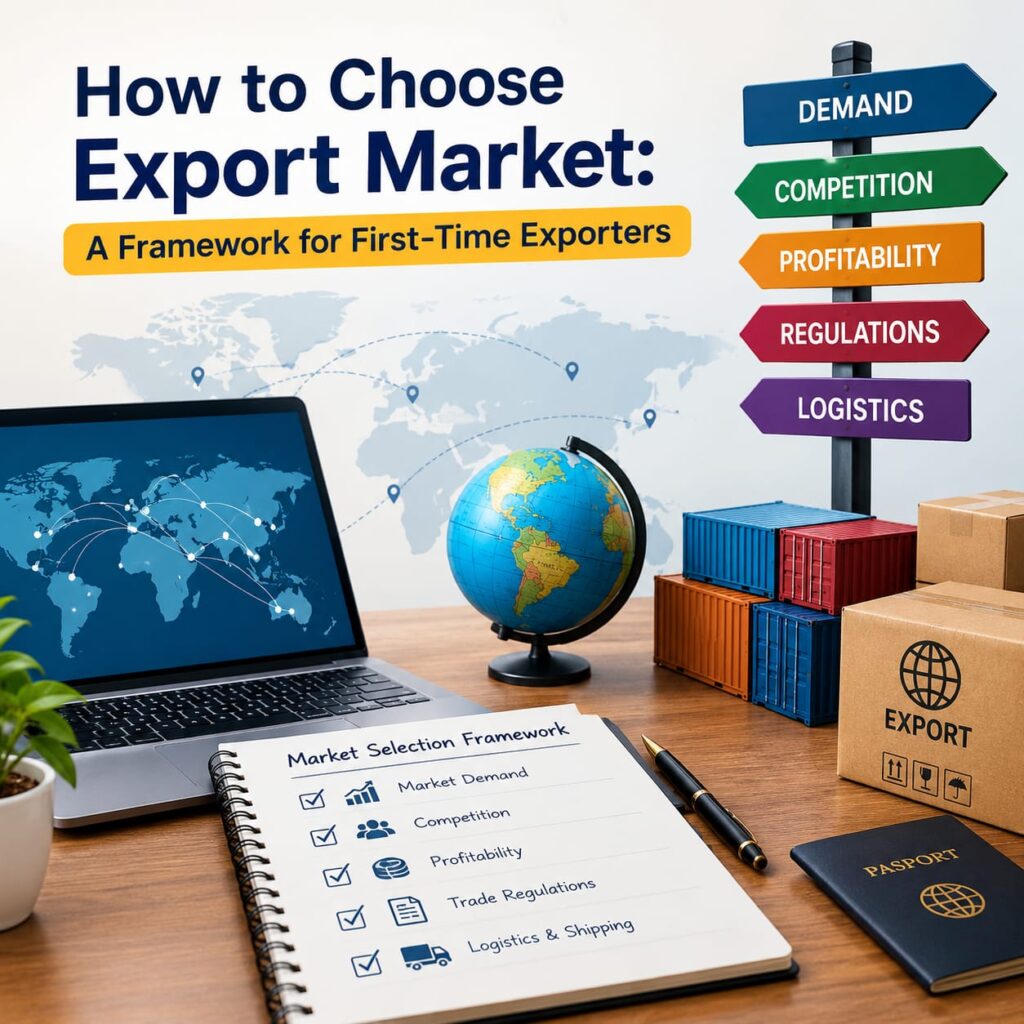
How to Choose Export Market: A Framework for First-Time Exporters

The instinct when picking a first export market is usually to chase the biggest economy or the fastest-growing demand, which often leads first-time exporters straight into markets that are hardest to actually succeed in. . How to choose export market is less about which country has the most potential and more about which country a specific business can realistically serve well, given its product, its resources, and its tolerance for complexity. Getting this decision right the first time matters more than it seems, since a failed first export attempt tends to be expensive and discouraging enough to delay a second attempt for years. Why Market Size Is the Wrong Starting Metric Large, high-profile markets attract first-time exporters precisely because of their size, which is exactly why they’re often the most competitive and hardest to break into. Export strategy research consistently warns against prioritising market size over market accessibility for a first export attempt, since a smaller market with fewer entrenched competitors, simpler regulatory requirements, and a genuine, specific gap in supply often produces a far better first experience than a massive but saturated market where a new, unknown exporter has no real foothold. Why Demand Has to Be Specific, Not Just Present Generic demand for a product category in a country doesn’t guarantee that demand actually fits what a particular business produces. Market research guidance for exporters emphasises verifying demand for the specific variant, specification, or price point a business actually sells, rather than demand for the broad category. A country can import large volumes of a product type while overwhelmingly favouring a different grade, size, or price tier than what’s being offered, which makes that market functionally closed to a new exporter despite looking attractive on the surface. Why Regulatory Complexity Deserves an Early, Honest Look Every destination country has its own import regulations, and the complexity of those regulations varies enormously by product category and by country. Trade compliance research finds that underestimating regulatory and certification requirements is one of the most common reasons a first export shipment gets delayed or rejected, since a market requiring extensive product testing, labelling changes, or specific certifications can turn what looked like a simple opportunity into a months-long compliance project. Checking these requirements before committing to a market, rather than discovering them mid-shipment, is one of the clearest ways to avoid an expensive first attempt. Why Existing Trade Relationships Matter More Than They Seem To Trade agreements between a home country and a destination country can meaningfully change the actual economics of exporting there, sometimes enough to outweigh a larger but less favourable market elsewhere. Trade policy analysis shows that preferential tariff access under an existing trade agreement can significantly lower landed costs and improve competitiveness in a specific destination compared to a market with standard tariff treatment. Checking which markets carry a trade agreement or preferential tariff arrangement with the home country is a straightforward way to surface markets where the numbers work out better than their headline size would suggest. Why Logistics and Shipping Routes Shape the Real Cost of Entry Two markets with similar demand and similar regulatory requirements can still differ enormously in how practical they are to actually serve, largely because of logistics. Export logistics research points to shipping frequency, transit time, and freight cost as decisive factors in whether a market is commercially viable for a given product, particularly for perishable or time-sensitive goods, where an indirect or infrequent shipping route can erode margins or damage product quality before it ever reaches the buyer. A market with excellent demand but poor, expensive, or inconsistent shipping access is often a weaker choice than a smaller market with reliable, direct logistics. Why Cultural and Business Practice Differences Affect More Than Marketing Cultural fit is often treated as a branding concern, when it actually affects core business mechanics like negotiation style, payment expectations, and typical contract terms. International business research finds that mismatched expectations around business practices contribute meaningfully to failed early trade relationships, independent of product quality or price competitiveness. A market where business norms, payment timelines, or negotiation expectations differ sharply from what an exporter is used to adds a layer of friction that’s easy to underestimate until it’s actually being navigated in a live deal. Why a Market With an Existing Diaspora or Trade Link Often Performs Better Markets with an existing cultural, linguistic, or diaspora connection to the home country often provide a meaningful head start that’s easy to overlook in favour of a larger, unconnected market. Export research on market entry patterns notes that shared language, existing diaspora communities, or prior trade history reduce the practical barriers to entry by easing communication, building trust faster, and sometimes providing an informal network of contacts already familiar with both markets. This kind of soft advantage rarely shows up in trade statistics, but it frequently makes the difference between a first export relationship that gets off the ground smoothly and one that stalls on basic communication and trust issues. Why Competitor Presence Isn’t Always a Warning Sign Many first-time exporters treat the presence of established competitors in a market as a reason to avoid it, when competitor presence can actually confirm something valuable: that demand is real, and the market is accessible to outside suppliers. Export market research distinguishes between a market with a few entrenched competitors and one that is fully saturated and closed to new entrants, noting that the first scenario often leaves room for a new exporter with a genuine point of differentiation, better pricing, faster delivery, a specific product variant, while the second offers little realistic opening regardless of how good the product is. Checking how many active suppliers a market already has, and how they’re actually differentiated from each other, reveals more than simply counting whether competitors exist at all. Why Currency Stability Deserves a Place on the Checklist Currency risk is easy to overlook when evaluating a market for the first time, but it directly affects whether a deal

Blog

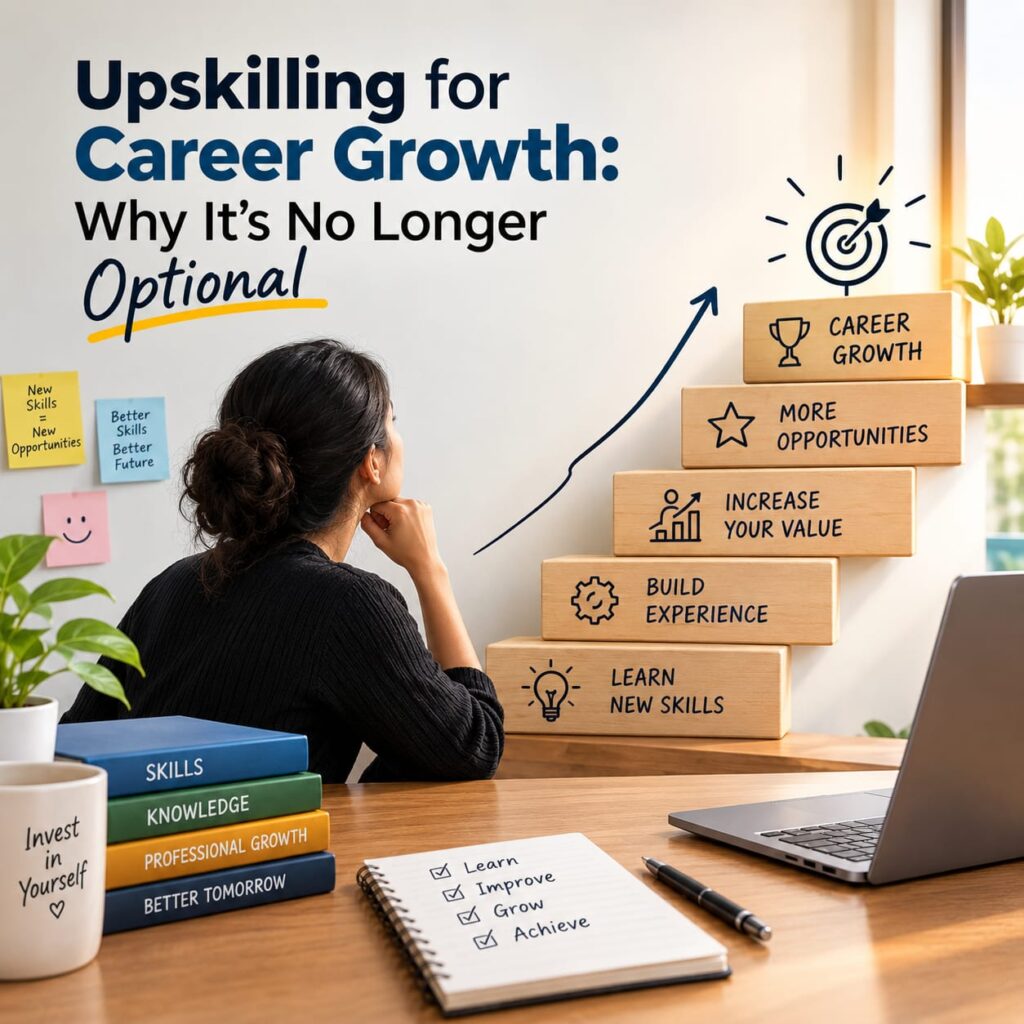
Upskilling for Career Growth: Why It’s No Longer Optional

A role that looked stable five years ago can quietly require a completely different skill set today, without anyone formally announcing the shift. Upskilling for career growth used to describe something ambitious people did to get ahead. Increasingly, it describes something almost everyone has to do just to avoid falling behind, since the skills a job was hired for and the skills it actually demands a few years later are drifting apart faster than most career plans account for. Why Job Requirements Are Changing Faster Than Job Titles A job title can stay the same for a decade while the actual work behind it changes substantially, which is part of why skill gaps often go unnoticed until they become urgent. Labour market research tracking skill requirements within fixed job titles finds that the specific skills associated with a given role shift meaningfully within just a few years, driven by new tools, new processes, and changing customer expectations, even when the job description itself hasn’t been rewritten. Someone doing “the same job” they started five years ago is often doing a noticeably different job in practice, whether or not their resume reflects that. Why Automation Changed the Calculation Much of the anxiety around upskilling traces back to how quickly automation and AI tools have started handling tasks that used to require a dedicated employee. Workforce research on automation’s labour impact consistently finds that routine, predictable tasks are the most exposed to automation, while judgment, creativity, and interpersonal skills remain comparatively resistant, which reframes the real risk. It isn’t that entire jobs disappear overnight; it’s that the portion of a job built on repeatable tasks shrinks, and the people who haven’t developed the judgment-based skills to fill that gap find their role quietly hollowed out from the inside rather than eliminated outright. Why Credentials Alone Stopped Being Enough A degree or certification earned at the start of a career used to function as a reasonably durable signal of competence for years afterwards. Workforce development research increasingly describes this signal as depreciating faster than it used to, particularly in technical and fast-changing fields, meaning a credential from several years ago says less about current capability than it once did. This doesn’t make initial education worthless, but it does mean the half-life of a credential has shortened, and relying on a single qualification earned early in a career to carry someone through decades of work is a riskier bet than it was for previous generations. Why Internal Mobility Increasingly Depends on Visible Upskilling Inside organisations, the link between demonstrated new skills and career advancement has become more direct than it used to be. Research on internal promotion patterns finds that employees who actively develop and demonstrate new skills are promoted and retained at meaningfully higher rates than those with similar tenure but a static skill set. This shifts the practical incentive: staying in place skill-wise doesn’t just risk falling behind the market; it directly reduces someone’s competitiveness for the next role inside their own company, where tenure alone increasingly counts for less than visible growth. Why Learning on the Job Rarely Covers the Full Gap A common assumption is that necessary skills get absorbed naturally just by doing the work, which turns out to be true only for a narrow slice of what’s actually needed. Workplace learning research finds that on-the-job exposure builds familiarity with existing tools but rarely develops the greater or more transferable skills that open up new roles or protect against a shifting job description, since day-to-day work tends to reinforce current methods rather than introduce genuinely new capability. Deliberate learning outside the current task, not just repetition of it, is usually what actually closes a meaningful skill gap. Why Adaptability Itself Has Become a Core Skill Beyond any specific technical skill, the capacity to learn something new quickly and repeatedly has become valuable in its own right. Career development research increasingly treats the ability to acquire new skills efficiently as a meta-skill that predicts long-term career resilience better than mastery of any single current skill does, since the specific tools and techniques in demand will keep changing regardless of which ones someone has already mastered. This is part of why employers increasingly screen for learning agility and curiosity alongside specific technical qualifications, treating the ability to pick up the next skill as valuable as whichever skill is currently in demand. Why Waiting for a Formal Program Often Means Waiting Too Long Many people associate upskilling with enrolling in a formal course or degree program, which can create unnecessary delay given how specific and fast-moving many skill gaps actually are. Workforce learning data shows that short, targeted learning- a focused course, a certification, structured self-study tied to a specific gap- closes practical skill gaps faster than broad formal programs in many fast-moving fields, since a multi-year program risks teaching material that’s already shifted by the time it’s completed. Treating upskilling as an ongoing, incremental habit rather than a single large undertaking tends to keep pace with how quickly the underlying requirements are actually moving. Why Peer Comparison Quietly Raises the Bar Skill expectations don’t just rise because of technology; they rise because the overall pool of candidates and peers is also upskilling, which resets what counts as competitive. Labour economics research on skill signalling finds that when a meaningful share of a workforce acquires a new skill, it shifts from a differentiator to an expected baseline for that role within a relatively short window. A skill that once set a candidate apart can become a bare minimum once enough peers have picked it up, which means standing still isn’t just risky relative to changing job requirements; it’s risky relative to everyone else who kept moving. Why Specialisation and Breadth Both Matter Now There’s a tension in how people are often advised to upskill: go deep into a speciality or build broad, adjacent capability, and the honest answer is that both have become more important rather than one replacing the other.

Blog

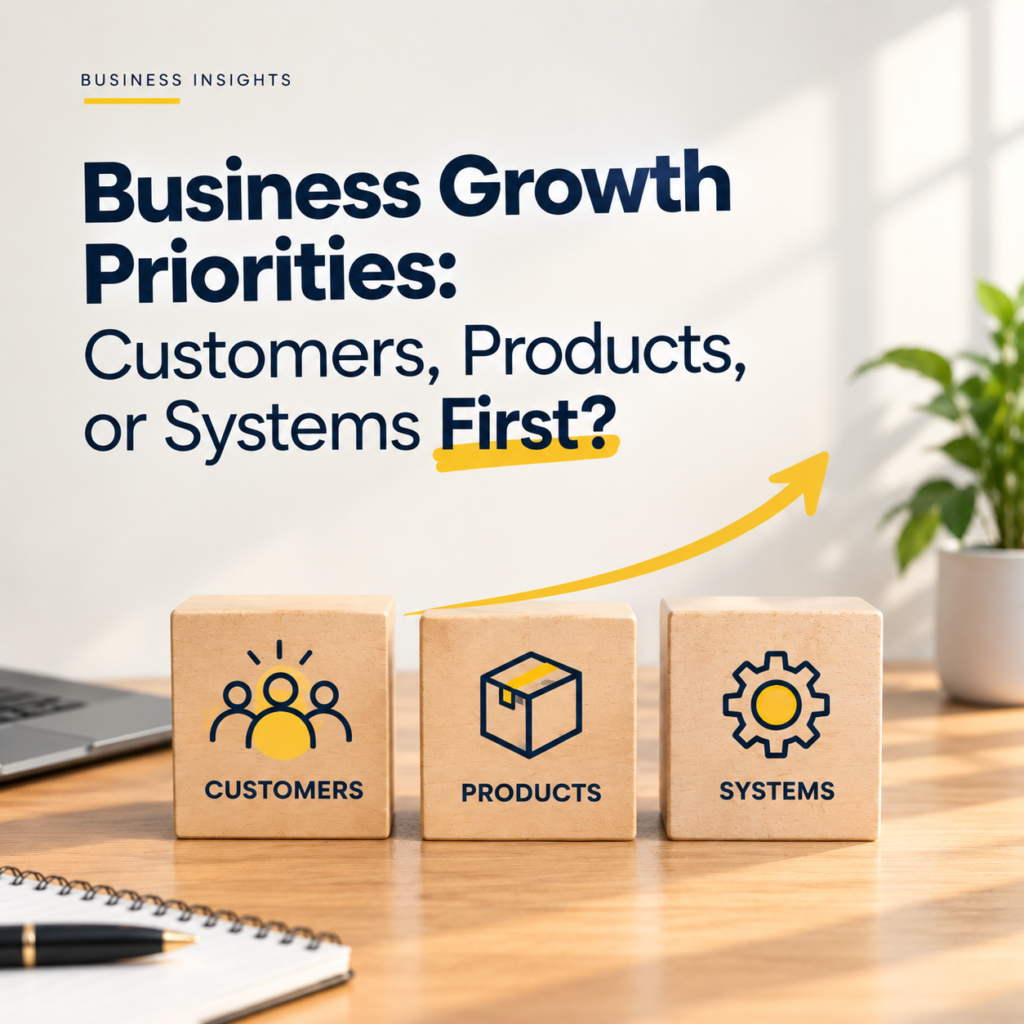
Business Growth Priorities: Customers, Products, or Systems First

Almost every growing business eventually faces the same three-way pull: chase more customers, build more products, or fix the systems running underneath both. Business growth priorities get treated as a matter of ambition: do all three as fast as possible, when the real constraint is usually sequencing. Pursuing the wrong one first doesn’t just waste effort; it often actively breaks whatever progress the other two were making. Why This Isn’t a Question of Which One Matters Most Framing customers, products, and systems as competing priorities assumes only one of them is actually important at a given time, which rarely reflects how a real business runs. Growth strategy research consistently frames the real question as which constraint is currently limiting growth, not which category is most valuable in the abstract, since a business can have plenty of demand and still stall because operations can’t deliver, or have excellent operations and still stall from a lack of customers. The right priority is whichever one is the actual bottleneck right now, not a fixed ranking that applies to every business at every stage. What Happens When More Customers Arrive Too Early Chasing customer growth before the underlying systems can support it is one of the most common ways a promising business damages itself. Operations research on scaling failures describes this pattern as demand outpacing fulfilment capacity, producing late deliveries, inconsistent quality, and overwhelmed support, all of which erode the trust that brought customers in the first place. A surge of new customers hitting a business that isn’t ready to serve them well often does more reputational damage than the growth itself was worth, since a bad first experience is far harder to undo than a slow start would have been. What Happens When Products Multiply Before Demand Is Proven Adding new products before the first one has found real, repeatable demand is a similarly common misstep, usually driven by the assumption that more offerings automatically means more revenue. Product strategy research consistently finds that expanding a catalogue before core demand is validated dilutes attention and inventory across too many unproven bets, spreading marketing budget, operational focus, and cash thin across products that haven’t earned the investment yet. A business with five mediocre products competing for the same limited attention usually underperforms a business with one product that’s been refined until it reliably sells. What Happens When Systems Get Built Too Far Ahead of Need The opposite mistake, investing heavily in infrastructure and process before the business has enough volume to justify it, is less commonly discussed but just as damaging to early-stage cash flow. Startup operations research warns against over-engineering systems for a scale the business hasn’t reached yet, since sophisticated inventory software, automated workflows, or a large support team built for future volume consume cash and management attention that current-stage demand doesn’t yet require. Systems built too far ahead of actual need often sit underused while quietly draining the resources a business needs for the stage it’s actually in. The Question That Actually Reveals the Right Priority Rather than debating which category deserves attention in the abstract, the more useful exercise is identifying where the business is actually failing right now. If customers are being turned away or delivery is falling behind, the constraint is systems, not demand. If the current customer base is satisfied but total revenue is flat, the constraint is likely customer acquisition. If the same limited group is buying everything on offer and asking for more, the constraint may genuinely be product range. Growth advisors describe this as diagnosing the binding constraint before allocating resources, since throwing effort at a category that isn’t actually limiting growth produces little return regardless of how well it’s executed. Why Systems Usually Deserve a Baseline Before Anything Else Even when customers or products are the more visible priority, a certain baseline of systems tends to be a precondition rather than an optional add-on. Research on early-stage operations finds that a minimum viable set of systems- reliable order tracking, basic quality control, and a way to actually fulfil what’s sold- has to exist before either customer growth or product expansion can be pursued safely. This isn’t the same as building elaborate infrastructure early. It means the absolute basics needed to deliver consistently have to be in place before either of the other two priorities is pushed hard, or growth in either direction risks breaking the business rather than building it. Why Revisiting the Priority Regularly Matters More Than Picking Correctly Once The binding constraint on a growing business rarely stays the same for long, which means treating this as a one-time decision tends to produce outdated priorities within a few months. A business that fixed its systems and successfully scaled customer acquisition often finds itself constrained by product range next, once the existing catalogue has been fully sold into the newly expanded customer base. Growth strategists generally recommend reassessing the binding constraint on a regular cadence rather than assuming last quarter’s answer still holds, since a business that keeps optimising whichever area was the priority six months ago, past the point that constraint has already been resolved, wastes effort exactly where it isn’t needed anymore. Why Cash Flow Often Decides the Order More Than Strategy Does Even a well-reasoned growth sequence can be overridden by a more immediate constraint: available cash. Small business finance research consistently identifies cash flow, not strategic preference, as the actual limiting factor behind most sequencing decisions in early-stage companies, since building systems, developing new products, and acquiring customers all require upfront spending before the corresponding returns arrive. A business with thin cash reserves often has to prioritise whichever investment pays back fastest, which is frequently customer acquisition through existing channels, rather than the option that looks best on a whiteboard but ties up cash for months before showing results. Why Team Capacity Limits How Many Priorities Can Move at Once Even with unlimited cash, a small team can only execute a limited number of initiatives well at

Blog

How to Use AI to Learn Faster and Actually Retain It

Reading more, watching more tutorials, and bookmarking more articles has never been the bottleneck in learning something new; the bottleneck has always been converting that information into something usable under real conditions. How to use AI to learn faster turns out to be less about consuming content quicker and more about closing the specific gap between knowing something and being able to apply it, a gap most traditional study methods were never built to address. Why Knowing and Doing Are Different Skills Cognitive scientists have long distinguished between two separate kinds of knowledge, and the difference explains why reading a concept rarely means someone can use it. Learning research describes declarative knowledge (knowing facts) and procedural knowledge (knowing how to do something) as requiring different kinds of practice to build, with procedural knowledge specifically requiring repeated, applied attempts rather than passive exposure. Someone can read an entire book on negotiation and still freeze in an actual negotiation, because reading built declarative knowledge while the moment demanded procedural skill the reading never touched. Why Passive Consumption Feels Like Progress but Often Isn’t Watching a tutorial or highlighting a paragraph creates a strong feeling of learning that doesn’t always match what you actually retain or can use. Research on learning illusions finds that familiarity with material is frequently mistaken for actual mastery of it, a gap that only becomes visible when someone is asked to apply the material without the source in front of them. This is part of why a course can feel productive to sit through and still leave almost nothing usable a month later; the sense of progress during consumption doesn’t reliably predict what survives contact with a real task. What AI Actually Changes About This Process AI tools shift the default mode of learning from consuming pre-made content to generating a response and getting immediate feedback on it, which is a meaningfully different activity. Instead of reading an explanation of a concept, someone can attempt to apply it, explain it back, or solve a problem with it, and get immediate, specific feedback on where the understanding actually breaks down, rather than discovering the gap much later on a test or in a real situation. That shift from passive intake to active attempt-and-correct is the mechanism doing most of the real work, not the novelty of the tool itself. Why Immediate Feedback Matters More Than More Content One of the most consistent findings across decades of learning research is that the speed and specificity of feedback strongly predict how quickly a skill develops. Educational psychology studies on feedback timing show that immediate, targeted feedback produces faster skill acquisition than delayed or generic feedback, which is exactly the gap traditional self-study struggles with; a wrong assumption or a misunderstood concept can sit uncorrected for weeks. An AI tool that flags a flawed explanation the moment it’s given closes that gap in real time instead of letting an error compound. Using AI to Explain Something Back, Not Just Ask Questions One of the more effective uses of AI in learning isn’t asking it questions at all; it’s explaining a concept to it and having it identify the gaps in that explanation. This mirrors a well-established learning technique researchers call the protégé effect, where teaching material to someone else improves the teacher’s own understanding of it more than studying it alone does, because explaining forces the gaps in understanding to surface. An AI tool willing to play the role of a confused student, asking follow-up questions and pointing out inconsistencies, gives access to that same effect without needing a real person available on demand. Turning Information Into Practice Scenarios A specific and underused way AI supports application is generating realistic practice scenarios that would otherwise take significant effort to construct: a mock negotiation, a sample client objection, a set of numbers to analyse using a newly learned framework. Skill-based training research emphasises that practice under conditions resembling the real task transfers far better than abstract review, and AI’s ability to generate an unlimited number of varied, on-demand scenarios removes what used to be the main obstacle to this kind of practice: finding or creating enough realistic material to practice against. Why Spaced, Applied Review Beats Rereading Rereading notes or a textbook chapter is one of the least effective study methods available, despite being one of the most commonly used. Memory research consistently shows that retrieval practice and spaced repetition produce better retention than passive review, since forcing the brain to reconstruct information from memory, rather than simply recognising it on a page, is what actually strengthens the memory trace. AI tools that generate quiz questions, prompt recall at increasing intervals, or ask someone to apply a concept in a new context are using this mechanism directly, rather than adding another pass of the same rereading that wasn’t working in the first place. The Risk of Using AI to Skip the Struggle Entirely AI’s ability to generate a complete answer instantly creates a real risk that cuts against the same learning mechanism it can otherwise support. Cognitive research on desirable difficulty finds that a certain amount of productive struggle is necessary for durable learning, and skipping straight to a generated answer without attempting the problem first removes that struggle entirely, producing a feeling of understanding without the retention that would normally come from wrestling with the problem. Used to hand over finished answers, AI can quietly undermine the same learning process it’s capable of accelerating when used differently. Why Personalisation Closes Gaps Generic Material Can’t Most books, courses, and tutorials are written for an average learner, which means they spend time on things a specific person already understands and rush past the one part that person actually finds confusing. Adaptive learning research shows that instruction tailored to an individual’s specific gaps produces faster progress than fixed, one-size-fits-all material, which is exactly the kind of tailoring a static book or pre-recorded course structurally cannot offer. An AI tool can ask what’s actually unclear

Blog

Entrepreneurial Observation Skills: How to Notice What Others Miss

Most business opportunities aren’t hidden; they’re simply ignored by people who have learned to stop seeing them. A clunky checkout process, a workaround everyone in an industry accepts, a complaint repeated so often it stopped sounding like a problem. Entrepreneurial observation skills are the habit of noticing these things instead of tuning them out, and they explain far more about why some people find opportunities than raw creativity or luck ever does. The raw material for most businesses is already sitting in plain view. Why Familiarity Makes Opportunities Invisible The reason most people walk past opportunities isn’t a lack of intelligence; it’s how the brain treats anything it encounters repeatedly. Cognitive research on attention describes this as habituation, where repeated exposure causes the brain to filter out a stimulus as unremarkable, which means the longer someone works in an industry or lives with an inconvenience, the less likely they are to register it as a problem worth solving. This is why outsiders and newcomers often spot obvious inefficiencies that veterans stopped noticing years earlier, simply because the newcomers haven’t yet learned to see past them. The Difference Between Noticing and Looking Passive exposure to a problem and deliberate observation of it are very different activities, and only the second reliably produces business ideas. Entrepreneurship researchers studying how founders identify opportunities distinguish between passively encountering a problem and actively investigating why it exists, noting that founders who build on an observation tend to ask follow-up questions most people skip: why does this happen, who is affected, what are they currently doing about it, and what does it cost them. The observation itself is only the trigger. The follow-up questions are what turn it into something with commercial shape. Where the Best Observations Tend to Come From Certain places reliably generate better observations than others, and experienced founders tend to return to the same handful of sources. Studies of successful startups repeatedly find that a large share began from a founder’s direct frustration with a problem in their own work or daily life, which gives them an advantage most market research can’t replicate: firsthand understanding of how the problem actually feels, how often it happens, and what a genuinely useful fix would need to look like. Personal friction is a surprisingly reliable starting point precisely because the person noticing it already has the context to judge whether a solution would actually work. Workarounds as a Signal of Unmet Need One of the most useful things to watch for isn’t a complaint at all; it’s a workaround. When people build a makeshift solution to get around a limitation- a spreadsheet standing in for missing software, a group chat doing the job of a proper tool, a manual process bolted onto an automated one- they’re demonstrating an unmet need more convincingly than any survey could. Innovation researchers point to user workarounds as one of the strongest predictors of viable product opportunities, since a workaround means someone cared enough about the problem to invest time and effort in a clumsy fix. That effort is exactly the kind of demand signal a better solution could capture. What Complaints Reveal That Compliments Don’t Positive feedback tells a business what’s working, but complaints tell a would-be founder where the gaps are, which is why the most useful observations often come from listening to frustration rather than praise. Customer research consistently finds that repeated, specific complaints point to unmet needs more reliably than general dissatisfaction, since a vague grumble might be about anything, while the same specific frustration raised by many different people across different contexts suggests a real, consistent gap. Paying attention to the phrases people use when they’re irritated, especially ones repeated across conversations, is often a faster route to a real opportunity than any brainstorming session. Why Cross-Industry Observation Produces Original Ideas Some of the most valuable observations come from noticing that a solved problem in one industry is still unsolved in another. Innovation research on idea origins finds that borrowing an established solution from one field and applying it to another is one of the most common paths to a genuinely novel business, since it combines a proven approach with a market that hasn’t yet seen it. This kind of observation depends on exposure to more than one industry or context, which is why founders with varied backgrounds, or those who deliberately spend time outside their own field, tend to spot connections that specialists rarely do. Why Timing Turns an Observation Into an Advantage Noticing something first only matters if the observation arrives while the gap is still open. Many opportunities exist because of a specific shift, a new regulation, a change in customer behaviour, a technology that just became cheap enough to use, and the window they create is rarely permanent. Business researchers studying market entry describe the moment a change makes an old problem newly solvable as one of the most productive times to act, since incumbents are still organised around the old way of doing things and slow to respond. Founders who pay attention to what has recently changed, not just what has always been broken, tend to find openings that competitors haven’t yet noticed exist. The Role of Curiosity Over Expertise Deep expertise can sharpen observation in one narrow area while quietly dulling it everywhere else, since specialists are the people most accustomed to how things are normally done. Studies of entrepreneurial cognition suggest that genuine curiosity about how and why things work often predicts opportunity recognition better than domain knowledge alone, because curious people keep asking questions about processes that experts stopped questioning long ago. This doesn’t mean expertise is a disadvantage. It means the strongest position is usually a combination of real knowledge and a willingness to keep asking naive-sounding questions about things that seem settled. How to Train the Habit Deliberately Observation sounds like a personality trait, but it behaves much more like a practice that improves with deliberate repetition. A simple habit is to keep a

Blog

Creativity in the Age of AI: What Actually Makes Work Stand Out

Anyone can now generate a passable image, a competent paragraph, or a decent logo concept in seconds, quietly turning a question that once mattered only to professional creatives into one almost everyone is asking. Creativity in the age of AI isn’t really a question about the tools themselves; it’s a question about what’s left to differentiate one person’s work from another’s once the baseline of technical execution stops being scarce. That answer turns out to be more specific, and more durable, than most of the anxiety around it suggests. What AI Actually Commoditised The disruption AI has caused in creative fields is real, but it’s aimed at a specific layer of the work rather than creativity as a whole. Researchers studying generative AI’s effect on creative industries describe the shift as collapsing the cost of execution while leaving judgment and taste largely untouched, meaning the parts of creative work that were always mechanical- rendering a draft, generating variations, producing competent-but-generic output- are the parts that got cheap almost overnight, while the parts that require deciding what’s actually good, and why, remain exactly as scarce as they were before. Why Taste Became the Scarce Resource Once generating options is nearly free, the actual bottleneck in any creative process shifts to whoever can tell which of those options is worth keeping. Design and creative-direction research on this exact shift consistently identifies curatorial judgment, the ability to select, refine, and reject, as the skill that gains value precisely because generation stopped being the constraint. A tool that can produce a hundred competent variations in a minute still can’t tell you which one actually serves the goal, and that judgment call remains entirely human, which is why the people getting the most out of AI tools tend to be the ones with strong enough taste to spot the one output worth keeping out of the pile. The Personal Experience an AI Model Can’t Draw On Generative models produce output based on patterns learned from existing work, which means by construction they can’t originate something rooted in an experience that never appeared in that training data. Writers and creative researchers examining this limitation point to lived, specific, personal experience as a category of material an AI model has no access to: a genuinely idiosyncratic memory, a specific professional insight earned over years, a particular emotional truth from a real event, all of which can inform a piece of work in a way no amount of prompting can substitute for. Work built from that kind of material carries a specificity that generated work, however polished, tends to lack. Why a Point of View Matters More Than Polish Now As technical polish becomes easier for everyone to achieve, it stops being the thing that differentiates work and starts being simply the baseline expected of anyone. Branding and content strategists studying this shift note that audiences increasingly respond to a clear, consistent point of view rather than to technical execution alone, since execution quality across a market compresses toward a similar ceiling while a genuine perspective, an opinion, a way of seeing a problem that isn’t shared by everyone else producing similar work, remains rare by definition. Work with nothing to say, however well-produced, increasingly reads as interchangeable with everything else using the same tools. The Trust Problem AI-Generated Work Runs Into A separate, less discussed dynamic is how audiences respond once they suspect, correctly or not, that something was AI-generated. Consumer research on AI disclosure and trust finds that audiences apply more scepticism to content they believe was AI-produced, particularly in contexts involving expertise, advice, or emotional content, even when the actual quality is comparable to human-made work. This creates a trust premium for visibly, verifiably human work in categories where credibility matters, a premium that has nothing to do with technical quality and everything to do with the audience’s model of who, or what, actually made the decisions behind it. Where Craft Still Beats Speed Not every category of creative work responds to this shift the same way. Domains where the audience directly experiences the process, not just the output- live performance, hand-made physical objects, work where visible skill is part of the value- continue to reward demonstrable human craft precisely because the craft itself is part of what’s being purchased, not just the result. A handmade piece of furniture or a live musical performance isn’t competing with an AI-generated equivalent in the same way a stock illustration is, because part of what’s being valued is the visible evidence of a human process, something generation can’t replicate no matter how good the final output looks. How to Actually Use the Tools Without Losing the Differentiator None of this argues for avoiding AI tools, since refusing a tool that speeds up the mechanical parts of a process rarely serves anyone. The more useful framing treats AI as a way to handle execution faster so more time goes toward the judgment and point-of-view work that actually differentiates the output, using it to generate a faster first draft, more variations to choose from, or a quicker rough pass, while keeping the selection, editing, and final decision-making squarely in human hands. The work that stands out tends to come from people who treat the tool as leverage for the parts that were never the differentiator to begin with, rather than a replacement for the parts that were. What This Actually Means for Anyone Creating Work Today The practical response to this shift isn’t panic or refusal; it’s a deliberate move toward whatever a given person or brand actually has that’s genuinely specific: real experience, a distinct point of view, a visible process, or a track record that can’t be generated on demand. Work that leans into what only a specific person could have made, rather than competing purely on production quality, is the work least affected by how cheap and widespread AI-assisted production has become, since the thing making it valuable was never the part that got automated. Conclusion

Blog

From Idea to Execution: What Actually Happens After You Have an Idea

Almost everyone has had a business idea worth pursuing at some point, and almost none of those ideas ever became an actual business. From idea to execution is the gap where that happens, or doesn’t, and it has very little to do with how good the original idea was. An idea is a hypothesis, nothing more, and what determines whether it survives contact with a real customer is everything that happens after it’s written down. Why the Idea Was Never the Hard Part Most people substantially overrate the difficulty of coming up with a good idea and substantially underrate the difficulty of everything that follows it. Founders who’ve built and studied multiple ventures consistently describe ideas as abundant and cheap relative to execution, pointing out that most successful companies weren’t first to their idea; they were simply the ones who executed it well enough, consistently enough, to outlast competitors who had the same idea earlier or arrived at it independently. This reframes the entire question: the scarce resource was never the idea itself; it was the discipline to carry it through the unglamorous steps that turn a concept into something a customer will actually pay for. What Validation Actually Requires The first real test an idea faces isn’t whether people say they like it; it’s whether anyone will do something costly to get it. Lean startup methodology built an entire framework around this exact distinction, arguing that stated interest and actual willingness to pay or commit time are two completely different signals, and that founders who rely on the first while skipping the second routinely build something nobody was ever going to buy. A friend saying “I’d definitely use that” costs them nothing and predicts almost nothing, while someone handing over a deposit, filling out a waitlist with real contact information, or committing time to a pilot is the kind of signal that actually says something about demand. The Version of the Idea Nobody Wants to Build First Once an idea clears basic validation, the instinct is usually to build the full version, and that instinct is almost always wrong. Product development research consistently finds that the most efficient path runs through a minimum viable product, deliberately stripped down to test the riskiest assumption first rather than a polished version of the whole vision, since building the full product before knowing whether the core assumption holds risks months of work on features nobody asked for. The discomfort of shipping something embarrassingly basic is usually the actual signal that the MVP is doing its job, since a version good enough to feel proud of is often a version that took too long and answered too few real questions. Why Most Ideas Die in the Gap Between Plan and First Customer The single largest drop-off between people who have an idea and people who have a business happens well before any product is finished, in the space between deciding to start and actually reaching a first real customer. Startup research on founder behaviour repeatedly identifies fear of an imperfect first version and an unwillingness to ask directly for money or commitment as the two most common reasons a promising idea never leaves the planning stage, more so than any lack of resources or market opportunity. Endless research, planning, and refining the idea itself becomes a way to feel productive while avoiding the much more uncomfortable step of putting something imperfect in front of a stranger and asking them to pay for it. What Changes Once Money Is Involved A business idea crosses an important threshold the moment real money changes hands, and that threshold matters more than most founders expect going in. Business advisors consistently observe that the questions a business has to answer shift entirely once revenue starts, moving from “does anyone want this” to “can this be delivered reliably, priced sustainably, and repeated at scale,” a set of operational questions an idea alone never has to face. This is usually the point where a founder discovers whether the idea was actually a business or just a product people were willing to try once, since repeat demand and operational reliability are a different test entirely from initial interest. The Systems That Have to Exist Before Growth Does An idea that survives its first real customers still isn’t a business until it can run without depending entirely on the founder’s direct, constant attention. Operations research on early-stage companies points to documented, repeatable processes as the actual dividing line between a founder with a side hustle and a founder with a business, since a process that lives only in one person’s head can’t be delegated, can’t scale past what one person can physically do, and disappears the moment that person is unavailable. Writing down how a task gets done, even a simple one, the first time it’s repeated is often the unglamorous step that quietly separates ventures that grow from ones that plateau at whatever a single founder can personally handle. Why Momentum Usually Beats a Better Plan Founders frequently delay execution to refine a plan further, assuming a better plan reduces risk, when in most early-stage ventures the opposite tends to be true. Research on iterative product development finds that real market feedback consistently outperforms internal planning at identifying what actually needs to change, since a plan built without customer contact is a set of assumptions no amount of additional internal debate can actually test. A rough version launched and adjusted based on real feedback typically reaches a viable business model faster than a more polished version delayed for months of additional planning, because the planning itself can’t answer the questions only real customers can. What Separates People Who Cross the Gap Across founders who successfully move from idea to running a business, the pattern that shows up most consistently isn’t unusual talent or a uniquely good idea; it’s tolerance for the specific discomfort each stage requires. Shipping something imperfect, asking a stranger for money, writing down a process instead of

Blog

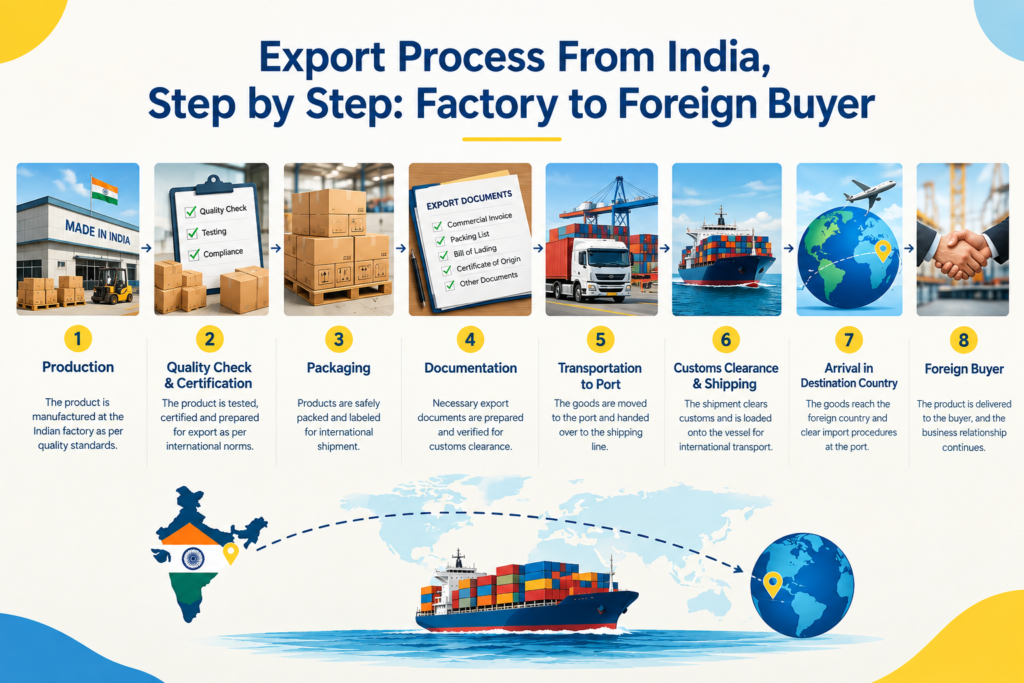
Export Process From India, Step by Step: Factory to Foreign Buyer

From the outside, exporting looks simple: a factory makes something, a buyer overseas wants it, a container leaves the port, money arrives. The export process from India actually runs through a long chain of documentation, inspection, and financial handoffs, most of which never gets mentioned until something in that chain goes wrong. Understanding what actually happens at each stage is usually the difference between a shipment that clears smoothly and one that sits stuck at a port for weeks. It Starts Long Before Anything Is Manufactured The export process doesn’t begin on the factory floor; it begins with paperwork that has to exist before a single unit is produced for a specific buyer. Trade compliance guidance for exporters consistently points to the Importer Exporter Code (IEC), issued by India’s Directorate General of Foreign Trade, as the mandatory starting point, without which no export shipment can legally leave the country regardless of how ready the product itself is. A signed purchase order or proforma invoice from the buyer typically follows, spelling out price, quantity, and delivery terms, and it’s this document, not a verbal agreement, that everything downstream- production planning, financing, insurance- actually gets built around. What the Terms of Trade Are Actually Deciding Buried in most export contracts is a short three-letter term that quietly decides who’s responsible for what, and at exactly which point risk shifts from seller to buyer. International trade rules define these as Incoterms, standardised shipping terms like FOB, CIF, or EXW, each assigning cost and risk differently between the exporter and the buyer at a specific handoff point in the journey. A factory shipping under FOB terms, for instance, is only responsible for the goods until they’re loaded onto the vessel, while CIF terms push that responsibility, and the cost of insurance and freight, onto the seller all the way to the destination port. Getting this term wrong in a contract is a common way exporters end up covering costs, or absorbing risk, they never actually agreed to. Where the Factory Floor Actually Fits In Once terms are locked and an order is confirmed, production itself is often the most predictable part of the whole chain, largely because it’s the part entirely within the exporter’s control. What happens here that buyers overseas actually care about is quality and compliance documentation generated during production, not just the finished goods themselves: batch records, testing certificates, and compliance with any destination-country standards the buyer specified, all of which have to be generated and retained as production happens, since recreating them after the fact is difficult and sometimes commercially damaging if a buyer requests proof mid-shipment. The Inspection Most First-Time Exporters Don’t Expect A finished, packed product doesn’t automatically move toward the port. Many export contracts, particularly with buyers in the US, EU, and parts of Southeast Asia, build in a third-party pre-shipment inspection requirement, where an independent inspection agency physically checks a sample of the finished goods against the buyer’s specification before shipment is authorised to proceed. This step exists specifically because the buyer has no way to physically see the goods before they arrive, and a failed inspection at this stage, rather than a dispute after arrival, is usually the cheaper and faster place to catch a quality mismatch, which is exactly why buyers insist on it even when it adds time to the schedule. The Paper Trail That Actually Moves the Goods Physical goods leaving a port are accompanied by a specific stack of documents, and missing even one of them is a common reason a shipment gets held at customs on either end. Standard export documentation includes a commercial invoice, packing list, bill of lading, and certificate of origin, along with any additional certificates the destination country requires for that specific product category, phytosanitary certificates for agricultural goods, or conformity certificates for electronics, as common examples. The bill of lading in particular functions as more than a shipping receipt: it’s the legal document that establishes title to the goods while they’re in transit, which is why banks and buyers alike treat it as the single most important paper in the entire shipment. How the Money Side Actually Works Payment on an international shipment rarely moves the way a domestic sale does, mostly because neither party is in a position to simply trust the other across a border and several weeks of transit time. A common structure for new trade relationships is a Letter of Credit (LC), a bank-issued guarantee that releases payment to the exporter only once the exact shipping documents specified in the contract are presented and verified, which protects the exporter from non-payment and the buyer from paying for goods that were never actually shipped. Established relationships often shift toward simpler terms like advance payment or open account trade over time, but that shift usually happens only after both sides have built enough trust through a few completed, dispute-free shipments. What Customs Clearance Is Actually Checking For Both ends of the shipment, the port of departure in India and the port of arrival at the buyer’s country, involve a customs clearance step that’s easy to underestimate until a shipment gets flagged. Customs authorities are primarily verifying that the declared value, product classification, and documentation all match what’s physically in the container, since a mismatch in any of these, even an honest clerical error, can trigger a hold, a fine, or a full inspection that adds days or weeks to a shipment already in transit. This is where accurate, consistent paperwork earlier in the chain pays off directly, since a shipment with clean documentation typically clears in a fraction of the time one with discrepancies does. The Part That Happens After the Goods Arrive The transaction doesn’t fully close the moment a container reaches the buyer’s port. The buyer still has to complete their own import clearance, pay any applicable duties, and formally accept the goods against the agreed specification, and it’s only after that acceptance that a Letter of Credit typically releases

Scroll to Top