

Blog

Your blog category

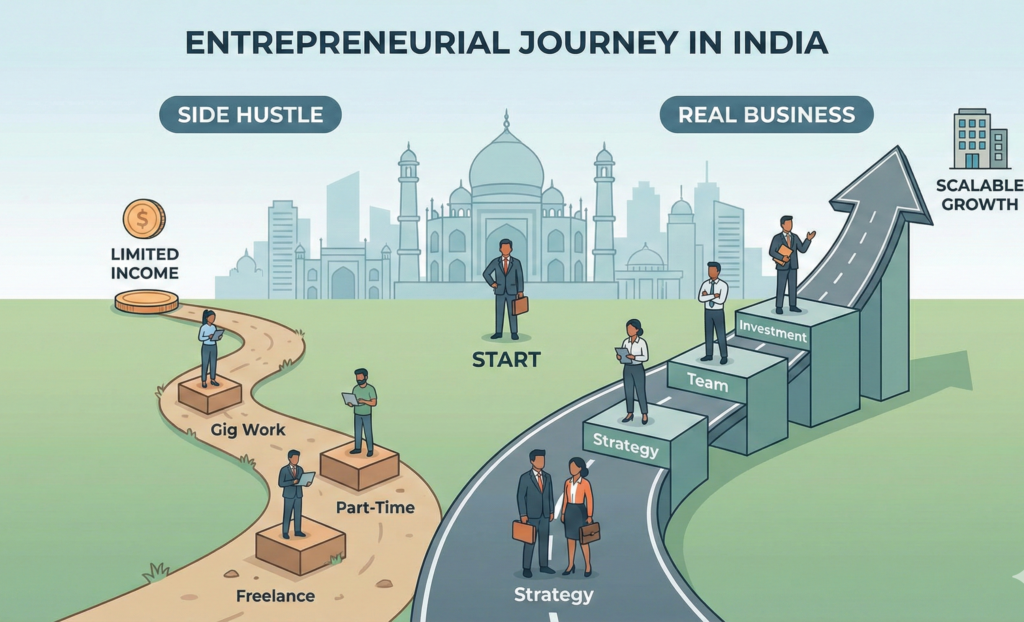
Side hustle vs real business comparison showing income and scalability differences
Blog

Side Hustle vs Real Business: What’s the Difference (2026 Guide)

Side Hustle vs Real Business: What’s the Difference The debate around side hustle vs real business has become increasingly common in India. Social media often glorifies side hustles as quick income solutions, while traditional businesses are seen as risky and complex. However, many people confuse the two. Understanding the difference is critical before investing time, money, and energy. This article explains what separates a side hustle from a real business, how income behaves in each case, and which approach aligns better with long-term financial growth. What Is a Side Hustle A side hustle is an activity done alongside a primary job or occupation to earn extra income. It is usually time-dependent and skill-based. Common examples include freelancing, tutoring, content creation, delivery services, and small online gigs. Side hustles are easy to start and require low initial investment. Most people choose them because they offer flexibility and quick earnings without major risk. However, side hustles usually rely heavily on personal time. When time stops, income stops. What Is a Real Business A real business is built with systems, processes, and scalability in mind. It is designed to grow beyond the individual’s daily involvement. A business generates income through repeatable models such as products, services, platforms, or structured partnerships. Unlike side hustles, businesses focus on long-term value creation. They involve upfront planning, learning, and sometimes capital, but they offer the possibility of compounding income over time. Core Difference Between Side Hustle and Real Business The biggest difference in the side hustle vs real business comparison is income behavior. Side hustles produce linear income. You trade time for money. If you work more hours, you earn more. If you stop, income stops. A real business produces scalable income. Systems, teams, and processes allow growth without a proportional increase in personal time. This single difference determines long-term outcomes. Income Potential Comparison Side hustles typically have income limits. Freelancers may increase rates, but they still face time constraints. Burnout becomes a common issue. Businesses, on the other hand, have no fixed income ceiling. Growth depends on market demand, operational efficiency, and execution. This does not mean businesses guarantee high income. It means they allow it. Risk and Stability Perspective Side hustles feel safer because they require low investment. However, they are often unstable. Platform changes, client loss, or health issues can instantly stop income. Businesses carry higher initial risk but offer greater control. With diversified customers and structured operations, income stability improves over time. Risk is not about avoiding investment. It is about reducing dependency. Time Involvement and Lifestyle Impact Side hustles demand continuous personal involvement. Even successful hustlers remain busy handling tasks themselves. A real business initially requires high effort but gradually reduces dependency on the founder. Delegation and automation become possible. This difference impacts lifestyle, stress levels, and long-term sustainability. Skill Development Difference Side hustles usually sharpen one or two skills such as writing, teaching, or design. Businesses force broader learning. Sales, marketing, operations, leadership, and financial management become essential. This skill expansion increases long-term career value even beyond business outcomes. Why Most People Stay Stuck in Side Hustles Many people never transition from side hustle to business because they prioritize comfort over growth. Side hustles provide immediate income but discourage system-building. Without reinvestment and planning, they remain small. Another reason is lack of guidance. Building a real business without structure leads to confusion and early failure. When a Side Hustle Makes Sense Side hustles are ideal when the goal is short-term income, experimentation, or skill testing. They are useful for students, early professionals, or anyone exploring interests with minimal risk. However, expecting a side hustle to create long-term wealth often leads to disappointment. When a Real Business Makes Sense A real business is suitable when the goal is income growth, ownership, and independence. It requires patience, capital discipline, and learning. The rewards come later but are more sustainable. For professionals facing income stagnation, structured business models offer a transition path without quitting jobs abruptly. Side Hustle to Business Transition Many successful businesses start as side hustles but evolve intentionally. The transition happens when the focus shifts from doing work to building systems. Pricing, delegation, and branding become priorities. This shift separates earners from builders. Final Verdict The side hustle vs real business debate is not about choosing one over the other blindly. It is about clarity. Side hustles offer flexibility and quick income but limited growth. Real businesses demand effort and planning but offer scalability and ownership. Understanding the difference helps individuals align actions with goals. The mistake is not choosing a side hustle. The mistake is expecting it to behave like a real business.

How to start a business while doing a job in India step by step
Blog

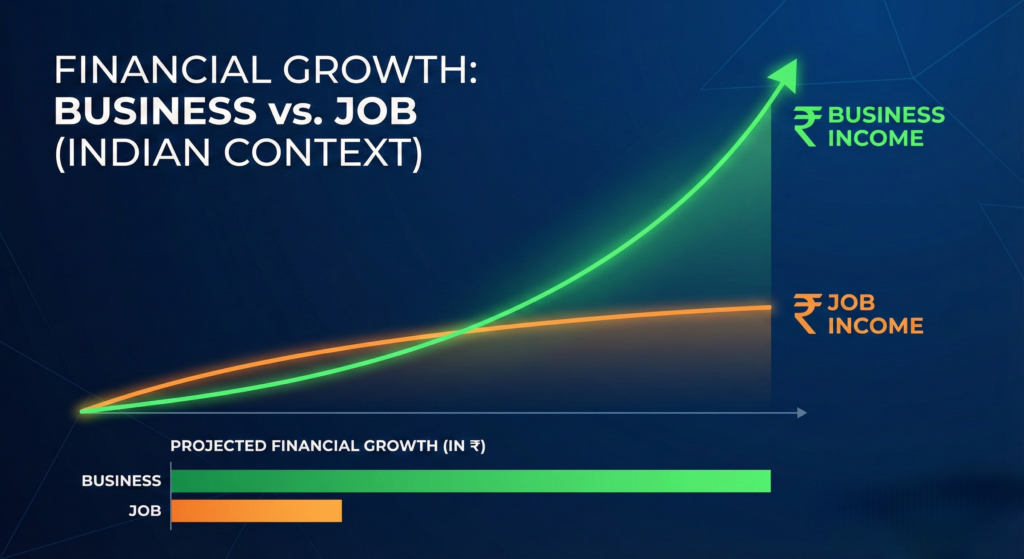
How to Start a Business While Doing a Job (Step-by-Step Guide 2026)

Starting a business while doing a job is no longer an exception in India. With rising living costs, slow salary growth, and limited career upside, many professionals are looking for ways to build an additional income stream without risking their primary salary. Learning how to start a business while doing a job requires clarity, discipline, and realistic expectations. This guide explains the process step by step, covering mindset, legal considerations, time management, and business models that work best for working professionals. Why Starting a Business While Doing a Job Makes Sense A full-time job provides stability but often limits income growth. Most professionals experience incremental salary hikes, while expenses grow faster over time. Starting a business alongside a job allows you to build long-term income potential without giving up financial security. The key advantage of this approach is risk management. You experiment, learn, and build systems while your job continues to fund your living expenses. This reduces pressure and increases your chances of success. Step 1: Choose the Right Business Model Not all businesses are suitable for job-holders. Avoid models that demand full-day involvement or unpredictable schedules. The best businesses to start while doing a job share three traits. They are skill-based, system-driven, and scalable. Examples include consulting, coaching, education services, digital marketing, content-led businesses, and structured partner models. These allow flexible hours and can be scaled gradually. Avoid businesses that require daily physical presence, heavy inventory, or continuous supervision in the early stages. Step 2: Check Employment and Legal Constraints Before starting, review your employment contract carefully. Some companies restrict outside business activities, especially those related to the same industry. If there is a conflict clause, ensure your business does not compete with your employer or use company resources. Transparency and ethical separation are critical. From a legal standpoint, many professionals begin as sole proprietors. This simplifies compliance and allows easy income reporting. As revenue grows, the structure can evolve. Step 3: Manage Time Without Burning Out Time management is the biggest challenge when starting a business while doing a job. Successful professionals follow a fixed routine. Early mornings, late evenings, or weekends become focused work slots. Consistency matters more than long hours. Instead of trying to do everything, prioritize high-impact activities such as customer acquisition, service delivery, and system creation. Avoid unnecessary tasks that drain energy without moving the business forward. Step 4: Start Small but Think Long Term One common mistake is expecting fast results. Side businesses take time to mature. The initial goal is not high income but validation. You want to confirm that customers are willing to pay and that the business model works with limited time. Once validation is achieved, you can refine pricing, improve systems, and gradually increase involvement. This phased approach prevents frustration and reduces the risk of quitting too early. Step 5: Separate Job Income and Business Finances Financial discipline is essential when running a business alongside a job. Keep business income and expenses separate from personal accounts. Reinvest early profits instead of spending them. This accelerates growth and builds stability. Your job income should continue to cover personal expenses, while business income is used to strengthen operations and marketing. This separation creates clarity and prevents emotional decision-making. Step 6: Build Systems, Not Dependency A business that depends entirely on your time cannot scale. Focus early on creating repeatable processes. Document workflows, standardize services, and use simple automation tools where possible. The objective is to reduce dependence on daily involvement so that the business grows even when your job demands attention. This step determines whether your side business remains small or evolves into a full-time opportunity. Step 7: Learn Business Skills Actively Many professionals fail not because of lack of effort, but because of lack of business knowledge. Sales, marketing, pricing, customer psychology, and operations are critical skills. Learning these intentionally shortens the trial-and-error phase. Structured learning environments and mentorship-based programs significantly improve outcomes compared to self-learning alone. Step 8: Know When to Transition Quitting a job too early is risky. Staying too long can limit growth. A smart transition happens when business income becomes consistent and systems are stable. Many professionals wait until business income reaches at least 1.5 to 2 times their salary before considering a full-time shift. The decision should be data-driven, not emotional. Common Mistakes to Avoid Many people underestimate effort and overestimate speed. Others choose the wrong business model or ignore legal constraints. Trying to copy someone else’s journey without considering personal strengths is another common error. Every business path is individual and requires customization. Avoid comparing early-stage business income with long-term job income. They operate on different timelines. Final Thoughts Learning how to start a business while doing a job is about patience, structure, and intelligent risk management. Jobs provide stability. Businesses create scalability. Combining both strategically allows professionals to build income, skills, and confidence without unnecessary pressure. With the right model, disciplined execution, and continuous learning, a side business can evolve into a sustainable long-term opportunity. The goal is not to escape a job overnight, but to design a future with options.

Blog

Job vs Business in India: Income Growth Comparison (Data Study 2026)

Job vs business income growth is one of the most discussed questions among working professionals in India today. While jobs offer stability, businesses promise scalability. But beyond opinions and motivation, what does the data actually say? This article breaks down the reality using three clear, data-backed charts. Each chart highlights a different stage of the income journey, from salary growth trends to long-term wealth creation and finally to structured business ownership through a proven education-led model. The goal is not to glorify risk or undermine jobs, but to help readers understand income behaviour over time and make informed decisions. Understanding Job Income Growth in India Average Salary Growth of Indian Employees A 10-Year Analysis The first chart highlights average salary growth across entry-level, mid-level, and senior-level professionals over a 10-year period in India. The data shows a consistent but slow upward movement. Entry-level professionals start around ₹3.6 lakh annually and reach approximately ₹5.4 lakh after a decade. Mid-level professionals grow from roughly ₹7.2 lakh to ₹10.8 lakh. Senior-level professionals increase from around ₹12 lakh to ₹14.5 lakh. This chart clearly demonstrates that job income grows steadily, usually between 6% to 10% annually. However, it also reveals a plateau effect. As professionals move deeper into their careers, income growth slows unless there is a major role change, industry switch, or overseas opportunity. The key insight from this chart is predictability. Job income is stable and structured, but its upside is limited by hierarchy, company budgets, and market cycles. Why Salary Growth Often Plateaus Mid-Career For most professionals, income progression is linear. Promotions take time. Salary hikes are incremental. Even high performers face ceilings. This is not a flaw in the job system. It is simply how structured employment works. Companies optimize for sustainability, not exponential income growth for individuals. This reality pushes many professionals to explore entrepreneurship, consulting, or side businesses. However, traditional businesses often fail because people underestimate risk, overestimate speed, and lack a system. This is where income growth comparison becomes important. Job vs Business Income Growth Over Time The second chart compares job income growth with business income growth over a 10-year period. Job income starts higher and grows slowly. Business income often starts lower but compounds rapidly over time. The chart clearly shows that in the early years, job income looks more attractive. From year four onwards, business income begins to overtake job income. By year ten, the gap becomes significant. This chart does not suggest that business is easy or guaranteed. Instead, it shows the power of scalability. A business is not limited by fixed increments. Growth depends on systems, execution, market reach, and skill leverage. This explains why individuals with successful businesses often earn disproportionately more after several years compared to salaried professionals. The Missing Piece: Why Most People Still Fail in Business If business income grows faster, why does everyone not become an entrepreneur? Because most people start businesses without structure. They start with no system, no mentorship, no brand support, and no proven process. As a result, early losses force them to quit before compounding can begin. This is why structured business models matter, especially for first-time entrepreneurs transitioning from jobs. Structured Entrepreneurship as a Middle Path The third chart introduces a structured alternative. It compares job income growth with a CSB Authorized Partner business model based on a 10-year proven education framework. The data clearly shows that the CSB Authorized Partner model starts with zero income during the setup phase. It requires an upfront investment of approximately ₹9 lakh. This is a business, not a shortcut. However, once operational, the income curve accelerates rapidly. Within three months, partners can start earning up to ₹3 lakh per month depending on execution, local demand, and effort. Over the years, income shows 100% to 150% year-on-year growth potential, unlike jobs where growth remains capped. The chart visually communicates one important truth. Structured businesses reduce chaos but do not eliminate hard work. The growth is real, but so is the effort. Why the CSB Authorized Partner Model Is Different Unlike traditional businesses, this model is built on education, training, and a demand-driven ecosystem refined over ten years. Partners do not start from scratch. They operate within a researched framework that includes curriculum, brand positioning, marketing systems, and mentorship support. This does not remove risk. It reduces uncertainty. For professionals stuck in salary plateaus but hesitant about unstructured entrepreneurship, this model provides a transition path from employee to business owner with defined systems. Job or Business: Making the Right Choice Choosing between job and business should never be emotional. It should be based on risk tolerance, financial readiness, skill level, and long-term goals. Jobs are ideal for those who value stability, predictable income, and lower risk. Businesses suit individuals who can commit time, capital, and effort with a long-term mindset. The charts in this article show one clear pattern. Income in jobs grows slowly but safely. Income in business grows faster but demands responsibility. Structured business models bridge the gap for those who want growth without chaos. Final Takeaway The job vs business income growth debate is not about right or wrong. It is about alignment. Data shows that jobs provide security but limited upside. Businesses provide scalability but require patience, capital, and execution. Structured models like the CSB Authorized Partner program demonstrate how risk can be managed through systems and experience. Before making any decision, individuals should assess their financial cushion, learning ability, and willingness to commit. Income growth is not accidental. It is designed.

sales skills for entrepreneurs
Blog

Sales Skills Every Young Entrepreneur Must Master

Sales Skills for Entrepreneurs: Why They Matter Today Sales skills for entrepreneurs are the foundation of every successful business. No matter how innovative your product or service is, it will fail without the ability to sell. For young entrepreneurs, sales is not just a department—it is a survival skill. In the early stages of a business, founders are the primary salespeople. Learning sales skills early helps entrepreneurs validate ideas, acquire customers, and generate cash flow without depending on large teams or external funding. Why Sales Skills for Entrepreneurs Are More Important Than Ever Markets today are competitive, fast-moving, and customer-driven. Entrepreneurs who master sales skills can: Without sales skills, even technically strong entrepreneurs struggle to survive. 1. Communication Skills: The Core of Sales Skills for Entrepreneurs Clear communication is the first and most important sales skill. Entrepreneurs must be able to: Good communication reduces objections and increases customer confidence. 2. Understanding Customer Psychology Sales skills for entrepreneurs go beyond talking—they require listening. Young entrepreneurs must learn to: When entrepreneurs understand customer psychology, selling becomes problem-solving, not persuasion. 3. Prospecting and Lead Generation Skills No sales process works without leads. Entrepreneurs should master: Consistent prospecting ensures steady business growth instead of random results. 4. Sales Pitching Skills for Entrepreneurs A strong sales pitch is: Sales skills for entrepreneurs include crafting pitches that: Young founders should practice pitching until it feels natural, not scripted. 5. Negotiation Skills Every Entrepreneur Needs Negotiation is not about winning—it’s about reaching mutually beneficial outcomes. Entrepreneurs must learn to: Strong negotiation skills protect profitability and brand perception. 6. Objection Handling: A Critical Sales Skill for Entrepreneurs Customers often say: Sales skills for entrepreneurs include learning how to: Objections are signals—not rejections. 7. Relationship Building and Trust Creation Long-term business success depends on repeat customers and referrals. Entrepreneurs should focus on: Trust converts one-time buyers into long-term clients. 8. Closing Skills: Turning Conversations Into Revenue Many young entrepreneurs struggle with closing. Sales skills for entrepreneurs include: Closing is not pushy—it is guiding customers toward a decision. 9. Sales Process and Systems Entrepreneurs must build simple sales systems early. This includes: A system-driven approach prevents missed opportunities and inconsistent results. 10. Learning Sales Through Real-World Practice Sales skills cannot be learned from theory alone. Young entrepreneurs should: Institutions like Catalyst School of Business (CSB) emphasize practical sales exposure, helping entrepreneurs develop real-world selling confidence. Common Sales Mistakes Young Entrepreneurs Make Avoiding these mistakes accelerates sales growth. How Strong Sales Skills Help Entrepreneurs Scale Faster Sales skills for entrepreneurs enable: Entrepreneurs who master sales build businesses that survive market changes. Final Thoughts: Master Sales Skills Early Sales is not optional—it is essential. Young entrepreneurs who develop sales skills for entrepreneurs early gain independence, confidence, and control over their business journey. Whether you are building a startup, service business, or personal brand, sales will always remain your most valuable skill. Learn it early. Practice it daily. Use it ethically.

/entrepreneurial-skills-for-students/
Blog

Entrepreneurial Skills College Students Must Learn to Succeed in Business

College is no longer just about getting a degree and finding a job. Today, many successful founders, startup owners, and business leaders began their entrepreneurial journey while still in college. Learning entrepreneurial skills for college students early provides a massive advantage. It allows students to: In a rapidly changing economy, skills matter more than certificates. This article explains the most important skills college students must learn to become successful entrepreneurs—practical, real-world, and relevant in 2026 and beyond. 1. Problem-Solving Skills (The Foundation of Entrepreneurship) Entrepreneurship begins with identifying and solving problems. Every successful business exists because it solves a real pain point: College students should train themselves to: Strong problem-solving skills help students validate business ideas before wasting time or money. 2. Communication Skills for Entrepreneurs Clear communication is one of the most underrated entrepreneurship skills in college. Students must learn to: Whether you are selling a product, hiring a team, or raising funds, communication decides outcomes. How students can improve: 3. Financial Literacy and Money Management Many student businesses fail not because of bad ideas—but because of poor money management. Entrepreneurial students must understand: Learning finance early helps students run sustainable businesses instead of burning money blindly. 4. Sales Skills (The Most Important Entrepreneurial Skill) No sales = no business. Sales is not manipulation—it is the skill of: Every entrepreneur, especially students, must learn sales. Ways students can practice sales: Sales experience builds confidence and real-world exposure faster than any textbook. 5. Digital Marketing Skills In today’s world, marketing is digital-first. College students aiming for entrepreneurship must learn: Digital marketing allows students to start businesses with low investment and high reach. It also enables: 6. Decision-Making and Risk Assessment Entrepreneurs make decisions daily—often with incomplete information. Students must develop the ability to: Entrepreneurship is not about avoiding failure; it’s about learning faster than others. Colleges rarely teach decision-making under uncertainty—students must develop this skill intentionally. 7. Time Management and Discipline Balancing studies, business, and personal life is challenging. Entrepreneurial students need: Without discipline, even the best ideas fail. Students who master time management early often outperform peers in both academics and business. 8. Networking and Relationship Building Success in business is rarely solo. Students must learn how to: Networking opens doors to: Platforms like LinkedIn, events, workshops, and business communities are excellent starting points. 9. Adaptability and Learning Mindset Markets change. Technology evolves. Consumer behavior shifts. The most successful student entrepreneurs are: Instead of asking “What should I study?”, entrepreneurs ask: “What skill should I learn next?” This mindset separates job-seekers from business builders. 10. Leadership and Team Management As student businesses grow, founders must lead teams. Leadership skills include: Students who learn leadership early build businesses that scale beyond themselves. 11. Understanding Legal and Business Basics Entrepreneurial students should also understand: This protects businesses from legal issues and builds credibility. 12. Execution Over Perfection Many students delay starting because they want everything “perfect.” Entrepreneurs succeed by: Execution matters more than ideas. College is the safest time to experiment, fail, and learn. How Colleges and Institutions Can Support Entrepreneurial Skills Forward-thinking institutions like Catalyst School of Business (CSB) focus on: This approach helps students build real businesses, not just resumes. Conclusion: Start Learning Entrepreneurial Skills Early The future belongs to creators, builders, and problem-solvers. College students who invest time in learning entrepreneurial skills gain: Degrees may open doors—but skills build businesses. Start early. Learn practically. Build real-world experience before graduation.

student entrepreneurs building real businesses
Blog

How Students Can Build Real Businesses Before Graduation (Proven Guide)

Students today no longer need to wait for a degree, job offer, or MBA to start a business. With access to digital tools, low-cost platforms, and real-world mentorship, students can build real businesses before graduation—businesses that generate revenue, customers, and practical experience. This article explains how students can build real businesses before graduation, step by step, without unrealistic hype or risky shortcuts. Whether you are in college, university, or your final year, this guide will help you think and act like a real entrepreneur. Why Students Should Build Real Businesses Before Graduation The traditional path—study, get a job, then think about business—no longer guarantees security. On the other hand, students who build businesses early gain: Most importantly, when students build real businesses before graduation, they stop depending entirely on placements and start creating options. What Does a “Real Business” Mean for Students? A real business is not: A real business has: Students don’t need huge capital. They need clarity, consistency, and execution. Step 1: Choose a Business Model Students Can Manage When students try to build real businesses, the biggest mistake is choosing ideas that are too complex or capital-heavy. Best business models for students: The goal is not scale on day one—it’s learning how business actually works. Step 2: Solve a Real Problem You Understand Students already live in multiple problem-rich environments: Successful student entrepreneurs identify pain points they see daily. Examples: When students build real businesses around familiar problems, execution becomes easier. Step 3: Start Small, But Charge From Day One Many students delay charging money because they feel “not ready.”This mindset blocks real learning. Charging money: Even ₹2,000–₹5,000 per client is enough to turn a student project into a real business. Step 4: Learn Business Skills Alongside Academics To build real businesses before graduation, students must develop business skills, not just technical skills. Key skills include: These skills are rarely taught properly in colleges—but they decide business success. Step 5: Use Digital Platforms to Build Visibility Students have one major advantage: time + digital fluency. Platforms students can use: Consistency matters more than perfection.When students show their journey publicly, trust builds naturally. Step 6: Build Systems, Not Just Hustle A common trap for student entrepreneurs is working randomly without systems. To build real businesses, students should: Systems reduce burnout and allow students to manage business alongside studies. Step 7: Balance College and Business Strategically Building a business before graduation does not mean ignoring academics. Smart student entrepreneurs: The goal is sustainable progress, not overnight success. Step 8: Learn From Mentors Who Have Built Businesses Students often learn from: What actually helps is learning from people who have built, failed, and scaled real businesses. Mentorship reduces mistakes, speeds up learning, and provides clarity. Step 9: Focus on Profit, Not Just Ideas Ideas don’t build businesses—profits do. Students should track: Even small profits teach more than big ideas with no execution. When students build real businesses before graduation, they understand money practically—not just academically. Step 10: Use the Business as a Career Asset Even if a student decides not to continue the business full-time, the experience becomes a powerful asset. Benefits include: Many successful founders started businesses as students—not to become rich overnight, but to learn early. Common Mistakes Students Should Avoid Avoiding these mistakes increases the chances of building a real, sustainable business. Why Building a Business Before Graduation Matters More Than Ever The future favors: Students who build real businesses before graduation don’t just prepare for jobs—they prepare for ownership, leadership, and independence. Final Thoughts Building a real business as a student is not about shortcuts or hype. It’s about: Students who take this path graduate with something more valuable than a certificate—real-world business experience.

Earn 1 Lakh rupees profit as student
Blog

How to Make Your First ₹1 Lakh Profit as a Student Entrepreneur

Making your first ₹1 lakh profit as a student entrepreneur is more achievable in 2026 than ever before. You don’t need heavy investment, a fancy office, or connections. You need clarity, skills, consistency, and a smart business model that works while you’re still in college. Whether you’re studying engineering, BBA, BCom, arts, or even preparing for competitive exams, this guide will show the exact step-by-step path to earn your first lakh — ethically, sustainably, and fast. ⭐ Why Student Entrepreneurs Have an Advantage Most students mistakenly feel they “lack experience.”In reality, students have massive advantages: 1. Low personal financial responsibilities You can take small risks that adults with families cannot. 2. Easy access to peers as first customers Your college itself becomes your test market. 3. You learn faster than older entrepreneurs Young brains adapt to digital tools, trends, and skills instantly. 4. You can start a business with ₹0–₹5,000 Most student businesses today require skills, not capital. If you have smart execution and patience, your first ₹1 lakh profit can come in weeks or months. 🧩 Step 1: Choose a Business Model That Can Make ₹1 Lakh Fast Here are the 6 most realistic, proven & profitable models for students in India. 1. Freelancing (Digital Skills Business) Perfect for:Students with skills like editing, designing, writing, or social media. Popular services: Income potential:₹15,000 – ₹80,000 per clientYour first lakh? Possible in 1–2 months. 2. Reselling (Zero-Investment Selling Business) You can sell: You do not keep inventory. You just connect buyers and sellers. Income potential:₹15,000 – ₹50,000 per monthLow risk + high margin → great for beginners. 3. College Campus Services Business You can start simple but highly demanded services: Income potential:₹30,000 – ₹1,00,000 per month depending on hustle. 4. Content Creation + Monetization YouTube, Instagram, LinkedIn, Twitter (X), or blogging. Monetization options: Income potential:₹20,000 – ₹2,00,000/monthSlow to start, huge upside. 5. Online Teaching / Micro Coaching If you know: You can teach students online for ₹300–₹1,500/hour. Income potential:₹20,000 – ₹1,00,000/month. 6. Import-Export Micro Business Even as a student, you can start a micro-import or micro-export service. Examples: For full export business, join a proper training like CSB’s IBTC Program (Internal link suggestion). 🎯 Step 2: Follow the “₹1 Lakh Profit Formula” Here’s a simple formula that works for students: Profit = (High-Demand Skill/Service) × (Consistency) × (Pricing Strategy) Breakdown: ❇️ Pick 1 skill or business❇️ Get your first 3–5 clients❇️ Raise pricing every 2–3 projects❇️ Improve skills → repeat Students who follow this earn ₹1 lakh faster than those who try 10 things at once. 💸 Step 3: Pricing Strategy That Helps You Hit ₹1 Lakh Use this ladder: Stage 1 — Start (₹500 – ₹1,500) Get first clients, build portfolio. Stage 2 — Growth (₹5,000 – ₹15,000) After 3–4 clients, raise pricing. Stage 3 — Premium (₹20,000 – ₹50,000) For high-value services like: At stage 3, earning ₹1 lakh takes just 2–5 clients. 🚀 Step 4: How to Get Your First 10 Customers (Fast) 1. Use Instagram + LinkedIn Post samples, reels, and your portfolio. 2. Use Fiverr + Upwork Freelancers earn globally while studying. 3. Tell friends you’re offering a service Your inner circle can be your first sales engine. 4. DM businesses with value Send: 5. Join college groups College clubs, societies, and events need services every week. 📍 Step 5: Build a System That Can Run While You Study To make ₹1 lakh consistently, system > effort. Build: This will make you look professional and increase trust. 🧠 Mindset Shift: Why Most Students Never Earn ₹1 Lakh Not because they lack skills. But because they:❌ overthink❌ try too many things❌ expect fast results❌ fear rejection❌ don’t market themselves The ones who win are not the most talented —they are the most consistent and visible. 🏆 Conclusion Your first ₹1 lakh profit as a student entrepreneur is not luck — it is a system. Pick one business. Build skill. Market loud. Deliver well.Your first lakh will come faster than you think. And if you want structured mentorship, consider learning with CSB’s entrepreneurship & export programs

Bootstrapped Business in India
Blog

How to Start a Bootstrapped Business in India (2026 Guide)

Starting a business without external funding may sound risky, but in reality, some of India’s largest companies—Zoho, Zerodha, InfoEdge—were bootstrapped for many years before they became profitable. Today, the rise of digital tools, low-cost marketing channels, and simplified compliance has made it easier than ever to build a bootstrapped business in India. This guide will walk you through everything you need to know—mindset, planning, product building, marketing, finances, legal setup, and scaling—without depending on investors. 🧭 What Is a Bootstrapped Business? A bootstrapped business is a company that grows using its own internal cash flow, personal savings, or early customer revenue—not external investment. In India, bootstrapping is becoming more popular because: Bootstrapping forces you to think like a real entrepreneur: 🧘 1. Build a Strong Bootstrapped Founder Mindset Before you dive into execution, the mindset matters more than anything. Bootstrapped founders must learn to: The Indian startup ecosystem glorifies funding, but the entrepreneurship system rewards cash flow, not pitch decks. 🧠 2. Validate Your Business Idea Without Spending Money The biggest mistake new entrepreneurs make is burning money before validation. Use these low-cost validation methods: a) Talk to potential customers Interview 20–30 people who match your target audience.Ask: b) Create a WhatsApp group/MVP Don’t build a full product. Start with a basic service, Google Form, Notion page, or WhatsApp workflow. c) Pre-sell before building This is the secret sauce of bootstrapped founders.If someone pays you before you build the product → you’re on the right path. ⚙️ 3. Choose a Bootstrapped-Friendly Business Model Some business models require heavy capital. Avoid them. Best bootstrapped business models in India (2026): Avoid these if you are bootstrapping: 💰 4. Start Small: Minimum Viable Product (MVP) Your MVP should be the simplest version of your product that delivers the core value. Examples: The goal is not perfection but customer feedback. 📣 5. Market Your Bootstrapped Business on a Small Budget Marketing is where most new businesses waste money. Here are low-cost strategies that work in India: a) Leverage WhatsApp WhatsApp is the easiest platform for early traction: b) Build Authority on Social Media Pick one platform, not five.Choose based on your audience: Post consistently for 60 days before judging results. c) Content SEO (like this blog) Publishing blogs targeting long-tail keywords is a sustainable growth engine. Example topics for a bootstrapped founder: d) Cold Email + Cold DM Bootstrapped businesses grow on early direct outreach.Send 30–50 cold DMs every week on LinkedIn or Instagram. 📊 6. Handle Finances Like a Bootstrapped Entrepreneur Managing money is the heart of a bootstrapped business. Follow the 30-30-40 Formula: Build a 6-month runway Keep some money aside for: Never burn money assuming you’ll “fix it later.” ⚖️ 7. Register Your Business (Low-Cost Options) You don’t need to create a Pvt Ltd on Day 1. Start simple. Best legal structures for bootstrapped businesses: Additional essentials: Keep compliance low in the beginning. 👥 8. Build a Tiny but Effective Team (or Work Solo) Instead of hiring full-time employees, choose: Tools for affordable productivity: 📦 9. Start Selling Early — Don’t Wait Revenue is the oxygen of a bootstrapped business in India.Most founders delay selling because they want everything perfect. Here’s the formula for early sales: Even ₹20,000–₹50,000/month early revenue is enough to survive your first quarter. 📈 10. Scale Your Bootstrapped Business Sustainably Scaling should be slow, steady, and profitable. Ways to scale: The goal is not to grow fast — it’s to grow profitably. 💡 Examples of Bootstrapped Success Stories From India India has multiple bootstrapped legends: The pattern is clear:Bootstrapped founders build profitable companies while investor-funded founders build burn-heavy ones. ⭐ Conclusion: Starting a Bootstrapped Business in India Is Simpler Than You Think You don’t need funding, a big office, or a massive team.You need: A bootstrapped business in India succeeds when the founder focuses on solving problems, generating revenue, and building long-term systems not chasing investors.

international buyers for Indian spices
Blog

How to Find International Buyers for Indian Spices

What Are International Buyers for Indian Spices? International buyers for Indian spices are wholesalers, distributors, importers, food manufacturers, supermarkets, private label brands, and online retailers who purchase Indian spices in bulk for resale or processing. India is the largest spice exporter in the world (Source: Spices Board of India), which means global demand is constantly rising. (Reference: Spices Board of India — https://www.indianspices.com) Why Finding International Buyers for Indian Spices Is Not Difficult Today India exports over 1.5 million tons of spices every year, and countries like the USA, UAE, UK, Germany, Canada, and Australia are always looking for trusted suppliers.With the right approach, even a small exporter can find high-quality international buyers. Top 8 Proven Ways to Find International Buyers for Indian Spices 1. Use B2B Marketplaces to Find International Buyers for Indian Spices (Focus keyword placement)B2B platforms have become the fastest way to connect with verified global spice buyers. Best websites: ➡️ https://www.alibaba.com➡️ https://www.globalsources.com Pro tip:Upload high-quality product photos and include keywords like: 2. Contact Importers Through Spices Board Buyer Database The Spices Board of India regularly updates lists of international buyers for Indian spices. What you get: ➡️ https://www.indianspices.com/buyer-seller-meet 3. Attend International Food & Spice Trade Fairs This is the BEST method if you want long-term buyers. Top expos where you can meet international buyers for Indian spices: ➡️ https://www.gulfood.com 4. Use LinkedIn to Find Verified International Buyers LinkedIn is the most underrated platform for exporters. Search for: Steps: 5. Register on Government Export Portals These platforms help small exporters become visible globally. Must-register sites: ➡️ https://www.fieo.org 6. Use Freight Forwarders & Customs Agents Most freight companies already work with overseas importers.They can easily connect you to verified international buyers for Indian spices. Example: 7. Build Your Own Export Website (High Trust Factor) International buyers trust exporters with proper websites.A simple website with: Learn export website building inside our Business & Export Course:https://csbworld.com/courses/ibtc2/ 8. Email Marketing to Importers Send a buyer outreach email like: “Hello, we supply premium-grade turmeric, cumin, and red chilli from India. Attached is our catalog + lab test reports. Can we schedule a call?” Keep it short and professional. Which Indian Spices Have Highest International Demand? Bonus: Documents Needed to Export Indian Spices Conclusion Finding international buyers for Indian spices is not difficult if you follow structured methods—B2B portals, LinkedIn, export fairs, government portals, and a professional online presence. If you consistently build relationships and maintain quality, you can create a long-term, profitable spice export business from India.

Blog

How to Find Buyers for Export Business in India

Starting an export business from India can be one of the most profitable decisions for an entrepreneur. But before profits come buyers — and that’s where most exporters get stuck. Finding genuine, long-term buyers is the real key to success in international trade. In this guide, we’ll break down practical, proven ways to find buyers for your export business using both online and offline methods even if you’re starting small. 1. Start with B2B Marketplaces Online B2B platforms are the easiest way to reach global importers. Websites like Alibaba, IndiaMART, TradeIndia, and ExportHub allow Indian exporters to showcase products and connect directly with international buyers. Tips to attract buyers: 💡 Pro Tip: Regularly update your catalog. Consistent activity improves your visibility on these platforms. 2. Register with Export Promotion Councils (EPCs) Export Promotion Councils are government-recognized bodies that support exporters in specific industries. Some important EPCs include: Joining an EPC helps you access verified buyer databases, international trade fairs, and subsidy-linked export promotions. 3. Attend Trade Fairs and Buyer–Seller Meets Nothing builds trust faster than face-to-face meetings. Trade events such as India International Trade Fair (IITF), Vibrant Gujarat Summit, and IMEX India bring thousands of importers under one roof. How to make the most of trade fairs: Personal relationships often turn into long-term export contracts. 4. Leverage Digital Marketing and Social Media Your online presence is your 24×7 export showroom. Build a professional export website with your product catalog, certifications, and contact details.Then, use LinkedIn, Instagram, and YouTube to connect with potential importers. What works best: Digital visibility builds credibility and credible sellers get inquiries faster. 5. Use Indian Export Portals Government-backed websites like DGFT, FIEO, and ExportersIndia allow exporters to list their business for free. Through these portals, you can: These portals are trusted by both exporters and foreign importers, making them a safe starting point for beginners. 6. Connect via Indian Embassies and Trade Offices Indian embassies abroad have dedicated commercial wings that promote trade between India and their host countries. Visit the official India Trade Portal to access: This is a highly underused yet authentic way to find international buyers. 7. Partner with Freight Forwarders and Export Agents Freight forwarders and customs agents deal with importers daily. Many can connect you to genuine overseas buyers looking for specific Indian products. 🤝 Networking Tip: Build trust with your logistics partner. They often know which foreign companies are importing your type of product regularly. 8. Verify Buyers Before Finalizing Deals Before shipping any order, always verify the buyer’s credentials.Ask for their company registration details, importer certificate, and trade references. You can also use third-party agencies to check buyer authenticity.Taking these steps prevents fake inquiries and payment fraud. 9. Build Long-Term Buyer Relationships Sustainable export business growth comes from repeat buyers.Deliver consistent quality, maintain transparent communication, and provide after-sales support. A single satisfied buyer can bring multiple new referrals that’s the true power of relationship-based trade. 10. Learn with Experts: Join Export Business Courses If you’re new to exports, structured guidance helps you avoid costly mistakes. At Catalyst School of Business (CSB), our International Business & Trade Course (IBTC) helps entrepreneurs learn: 🎓 Learn from industry mentors who’ve built real export success stories. Conclusion Finding buyers for your export business in India takes strategy, consistency, and credibility.Start with online B2B platforms, join export councils, leverage digital tools, and learn from professionals. With the right approach, even small exporters can build a strong international buyer network and grow globally in 2026 and beyond. Outbound References APEDA India Trade Portal FIEO Official Website

Scroll to Top