
Blog

Your blog category

Blog

How AI Is Transforming Business Education in 2026

AI in business education is no longer a futuristic concept. It is already reshaping how students learn, how faculty teach, and how institutions prepare future entrepreneurs and professionals. Traditional business education once depended mainly on textbooks, case studies, and classroom lectures. Today, artificial intelligence is personalizing learning, automating assessment, enhancing decision making, and connecting students with real-world business environments. This transformation is not cosmetic. It is redefining what it means to be business ready in 2026. Why Business Education Had to Change The pace of business has accelerated dramatically. Markets evolve faster, technology reshapes industries, and new business models appear every year. Traditional curricula struggle to keep up with this speed. Students often graduate with theoretical knowledge but limited practical exposure. Employers demand data literacy, digital fluency, strategic thinking, and adaptability. AI in business education emerged as a response to this gap. It allows institutions to deliver dynamic content, simulate business scenarios, and prepare learners for real-world complexity. Personalized Learning Through AI One of the biggest contributions of AI in business education is personalized learning. Instead of one curriculum for all, AI systems analyze student behavior, performance patterns, and learning styles. Courses adjust automatically to individual needs. A student strong in finance but weak in marketing receives customized exercises and content. Another student struggling with analytics receives additional explanations and practice. This adaptive approach increases retention, engagement, and confidence. Personalized learning ensures that every learner progresses at an optimal pace rather than following a rigid schedule. Intelligent Tutoring and Virtual Assistants AI powered tutors now assist students around the clock. These systems answer questions, explain concepts, and provide instant feedback. Virtual assistants help students navigate courses, track deadlines, and access resources efficiently. This continuous support reduces dependence on classroom hours and enables self-directed learning. In business education, where concepts often build on each other, instant clarification prevents gaps from widening. Students gain autonomy while still receiving structured guidance. Simulation Based Business Learning AI enables sophisticated business simulations that mirror real market conditions. Students manage virtual companies, respond to competition, analyze data, and make strategic decisions. These simulations adapt based on user actions, creating dynamic scenarios that reflect real uncertainty. This form of experiential learning teaches decision making, risk assessment, leadership, and financial planning more effectively than static case studies. AI driven simulations prepare students for complexity rather than memorization. Data Driven Assessment and Feedback Assessment in traditional education often arrives too late to be useful. AI in business education changes this model. Intelligent systems analyze assignments, projects, and participation in real time. Feedback is immediate, detailed, and actionable. In courses such as accounting, operations, and analytics, AI highlights patterns, errors, and improvement areas instantly. Continuous assessment helps students correct mistakes early and build mastery gradually. Educators also gain insights into class performance trends, allowing targeted interventions. Curriculum Aligned With Industry Trends AI systems track global business trends, emerging skills, and evolving job requirements. Institutions can update curricula faster and more accurately. Courses incorporate new topics such as digital strategy, data driven marketing, automation management, and AI ethics. This alignment ensures graduates remain relevant in a rapidly changing job market. Business education becomes proactive rather than reactive. Enhancing Faculty Productivity AI assists faculty in designing courses, grading assignments, and monitoring student progress. Routine tasks are automated, freeing time for mentoring, research, and curriculum innovation. Faculty can focus on high-value activities such as coaching, industry collaboration, and leadership development. AI becomes a support system rather than a replacement, strengthening the educator’s role. Preparing Students for AI Driven Businesses Modern businesses increasingly rely on AI for forecasting, pricing, customer segmentation, supply chain optimization, and risk management. Business students must understand how these systems work, how to interpret their outputs, and how to make ethical decisions around their use. AI in business education introduces students to real tools used in industry. They learn not only how to use AI but also how to lead organizations that deploy it responsibly. Bridging the Gap Between Theory and Practice One of the biggest weaknesses of traditional business education is the disconnect between theory and execution. AI reduces this gap by embedding real data, live projects, and predictive analytics into coursework. Students analyze market trends, simulate investments, design marketing strategies, and forecast demand using current datasets. Learning becomes applied rather than abstract. This practical orientation improves employability and entrepreneurial readiness. Democratizing Access to Quality Education AI powered platforms expand access to business education beyond elite institutions. Students from smaller cities and diverse backgrounds can access advanced content, expert lectures, and global case studies online. Adaptive learning compensates for uneven prior preparation. Virtual classrooms connect learners across geographies. This democratization supports inclusive growth and talent development at scale. Ethical and Human Considerations While AI in business education offers immense benefits, it also raises important ethical questions. Data privacy, algorithmic bias, and transparency require careful governance. Business schools now teach AI ethics, data responsibility, and human centered leadership. Students learn that technology is a tool, not a substitute for judgment, values, and accountability. Human skills such as communication, creativity, empathy, and critical thinking remain central. Role of Institutions in the AI Era Institutions that embrace AI strategically gain a competitive advantage. They attract motivated students, build industry partnerships, and deliver measurable outcomes. Forward looking business schools integrate AI into pedagogy, operations, and research. They design programs that combine technology with entrepreneurship, leadership, and execution. This approach aligns perfectly with the future of business education. Future Outlook Over the next decade, AI will continue to reshape business education. Learning will become more modular, personalized, and outcome oriented. Credentials will reflect skills rather than seat time. Continuous learning will replace one time degrees. Business education will evolve into a lifelong partnership between learners, institutions, and industry. Final Thoughts AI in business education represents a fundamental shift rather than a passing trend. It transforms how knowledge is delivered, how skills are built, and how careers are shaped. Institutions that integrate AI thoughtfully prepare students for leadership in an intelligent economy. Students who


Blog

Why Hard Work Alone No Longer Guarantees Success

For decades, hard work was considered the ultimate formula for success. Study harder, work longer hours, stay loyal, and results would naturally follow. This belief shaped careers, businesses, and education systems for generations. Today, however, many hardworking people feel stuck despite putting in their best effort. At the same time, others move ahead faster with fewer hours but smarter outcomes. This shift raises a critical question: why does hard work alone no longer guarantee success? The Traditional Belief in Hard Work Earlier generations lived in a more stable economic environment. Industries changed slowly, technology evolved gradually, and competition was limited. A person who stayed disciplined, loyal, and consistent often saw predictable growth in income and position. Promotions were based on tenure, and businesses expanded steadily. In that context, effort directly translated into rewards because systems were simple and opportunities were evenly distributed. How the World of Work Has Changed The modern economy is entirely different. Technology automates routine tasks, global talent competes for the same roles, and industries evolve rapidly. Skills that were valuable five years ago can become outdated today. Startups disrupt established companies, and new business models replace old ones quickly. In this environment, working harder without adapting often leads to burnout instead of progress. Hard work still matters, but it is no longer the main deciding factor. Why Hard Work Alone Fails Today Effort without strategy produces limited results. Many professionals stay busy all day but focus on low-impact activities. They answer emails, attend meetings, and complete tasks, yet their career growth remains slow. Success today depends on working on the right problems, not just working longer hours. Strategy decides direction, and effort only decides speed. Without a clear direction, hard work simply accelerates the wrong path. Skills now matter more than hours. High-impact skills such as sales, leadership, negotiation, data analysis, and digital strategy create far more value than general effort. A skilled professional working six focused hours can outperform someone working twelve unfocused hours. Hard work amplifies skill, but without relevant skill, effort has diminishing returns. Systems now outperform individuals. In careers and business, repeatable processes produce better outcomes than raw effort. A salesperson with a strong follow-up system closes more deals than someone relying on energy alone. An entrepreneur with automated operations grows faster than one doing everything manually. Hard work without systems eventually reaches a limit. The Role of Opportunity and Timing Hard work cannot compensate for poor industry choice or bad timing. Many people work extremely hard in declining sectors with limited growth. Others enter expanding fields where opportunities multiply quickly. Success increasingly depends on choosing the right environment before applying effort. Working hard in the wrong context often leads to frustration rather than progress. Why Some People Succeed Faster Successful people are not lazy. They simply focus on leverage instead of labor. They choose skills that compound over time, build networks that multiply opportunities, and design systems that scale. Their effort is aligned with outcomes that grow automatically. Their success comes not from working more, but from working with leverage. Hard Work vs Smart Work vs Strategic Work Hard work focuses on effort. Smart work focuses on efficiency. Strategic work focuses on direction and leverage. Modern success requires all three, but strategy comes first. Without strategy, smart work only increases speed in the wrong direction. Hard work only increases fatigue. With strategy, even moderate effort produces strong results. Impact on Careers In careers, hard work alone often leads to stagnation. Employees who only execute tasks rarely advance quickly. Those who understand business impact, customer value, and organizational priorities grow faster. Promotions go to individuals who solve important problems, not those who stay late every day. Learning how value is created inside organizations matters more than simply working harder. Impact on Business and Entrepreneurship In business, effort without systems leads to burnout. Many entrepreneurs fail despite working extremely hard because they lack market insight, pricing strategy, customer understanding, or scalable models. Business success depends on designing processes, delegating well, and using technology effectively. Effort is necessary, but design determines outcomes. What Now Drives Success More Than Hard Work Modern success depends on four pillars. Skill relevance determines long-term value. Strategy determines positioning and direction. Systems determine scalability and sustainability. Adaptability determines survival in changing markets. Hard work strengthens all four, but cannot replace any of them. How Individuals Should Adapt The goal is not to work less but to work with purpose. Focus on building high-impact skills. Choose growth-oriented industries and roles. Understand how value is created in your field. Build systems that reduce dependence on personal time. Continuously update knowledge and adapt to change. Hard work remains essential, but it must be applied intelligently. Final Thoughts The belief that effort alone guarantees success belongs to an earlier era. In 2026, success comes from combining hard work with skill, strategy, and systems. Those who rely only on effort often feel exhausted and confused. Those who apply effort strategically experience faster growth, higher income, and better opportunities. Hard work is still important. It is simply no longer enough

Learning sales skills improves career growth and business outcomes
Blog

How Learning Sales Changes Career and Business Outcomes (2026 Guide)

Learning sales is often misunderstood. Many people associate sales only with cold calling or pushing products. In reality, sales is the foundation of every successful career and business. Whether you are an employee, entrepreneur, or student, learning sales fundamentally changes how you communicate, negotiate, and create value. In 2026, sales skills are no longer optional. They are a core life skill that directly influences income, leadership opportunities, and long-term growth. This article explains how learning sales impacts careers and businesses in measurable, practical ways. Why Sales Is the Most Transferable Skill Sales is not limited to selling products. It involves understanding people, identifying problems, and presenting solutions clearly. Professionals who learn sales communicate better with managers, clients, and teams. Entrepreneurs who master sales convert ideas into revenue. Leaders with sales skills influence decisions and drive outcomes. Unlike technical skills that may become outdated, sales skills compound over time. Impact of Learning Sales on Career Growth One of the most visible effects of learning sales is accelerated career growth. Employees with sales skills understand how organizations make money. They align their work with revenue impact rather than just tasks. This makes them more valuable to employers. Sales-trained professionals often move faster into leadership roles because they can influence outcomes, not just execute instructions. Promotions are driven by impact, and sales enables that impact. Sales Skills and Income Growth Income growth is closely linked to one’s ability to generate value. Professionals who learn sales negotiate better salaries, close better deals, and attract higher-paying opportunities. Freelancers with sales skills consistently earn more than technically stronger peers who lack client acquisition ability. In business, sales determines survival. A product without sales fails regardless of quality. Learning sales directly influences cash flow, stability, and scalability. How Sales Changes Business Outcomes Businesses succeed or fail based on their ability to acquire and retain customers. Founders who understand sales build businesses around customer needs rather than assumptions. They test ideas faster, reduce losses, and scale more efficiently. Sales-driven businesses adapt better to market changes because they stay close to customer feedback. This reduces risk and increases long-term sustainability. Sales Builds Confidence and Decision-Making Ability Learning sales forces individuals to face rejection, objections, and uncertainty. This builds emotional resilience and confidence. Professionals become more decisive and less dependent on external validation. Confidence gained through sales reflects in interviews, meetings, negotiations, and leadership interactions. This psychological shift alone changes career trajectories. Sales Skills Improve Leadership and Management Leaders are essentially sellers of vision and direction. Managers with sales skills motivate teams better, align stakeholders, and resolve conflicts effectively. They communicate goals in a way that inspires action rather than compliance. Learning sales improves listening skills, empathy, and persuasion, all essential leadership qualities. Why Sales Skills Matter More in 2026 The job market is changing rapidly. Automation is replacing routine tasks, but sales remains human-driven. Businesses value professionals who can bring customers, close partnerships, and generate revenue. Technical roles increasingly require client interaction and solution selling. Learning sales future-proofs careers by making individuals adaptable across industries and roles. Sales Skills vs Technical Skills Technical skills help you get started. Sales skills help you grow. Many technically strong professionals remain underpaid because they cannot communicate value. Meanwhile, individuals with moderate technical ability but strong sales skills advance faster. The ideal combination is technical competence supported by sales ability. How to Start Learning Sales Practically Sales cannot be learned only from theory. Practical exposure matters. Start by understanding customer psychology, communication frameworks, and negotiation basics. Practice through real interactions, not simulations alone. Structured learning environments, mentorship, and guided execution accelerate mastery and reduce trial-and-error. Common Misconceptions About Sales Many avoid sales thinking it is manipulative or aggressive. In reality, ethical sales is about problem-solving. Another misconception is that sales is only for extroverts. Effective sales depends more on listening than talking. Learning sales reshapes these beliefs and replaces fear with competence. Long-Term Career and Business Impact Over time, sales skills compound. Each interaction improves understanding. Each success builds credibility. Professionals with sales skills enjoy higher income ceilings, faster role transitions, and stronger professional networks. Businesses led by sales-aware founders scale sustainably. Sales is not a department. It is a mindset. Final Thoughts Learning sales is one of the most powerful investments an individual can make. It changes how careers progress, how businesses grow, and how opportunities are created. In a competitive and uncertain environment, sales skills provide control. Those who learn sales do not wait for opportunities. They create them.

Side hustle vs real business comparison showing income and scalability differences
Blog

Side Hustle vs Real Business: What’s the Difference (2026 Guide)

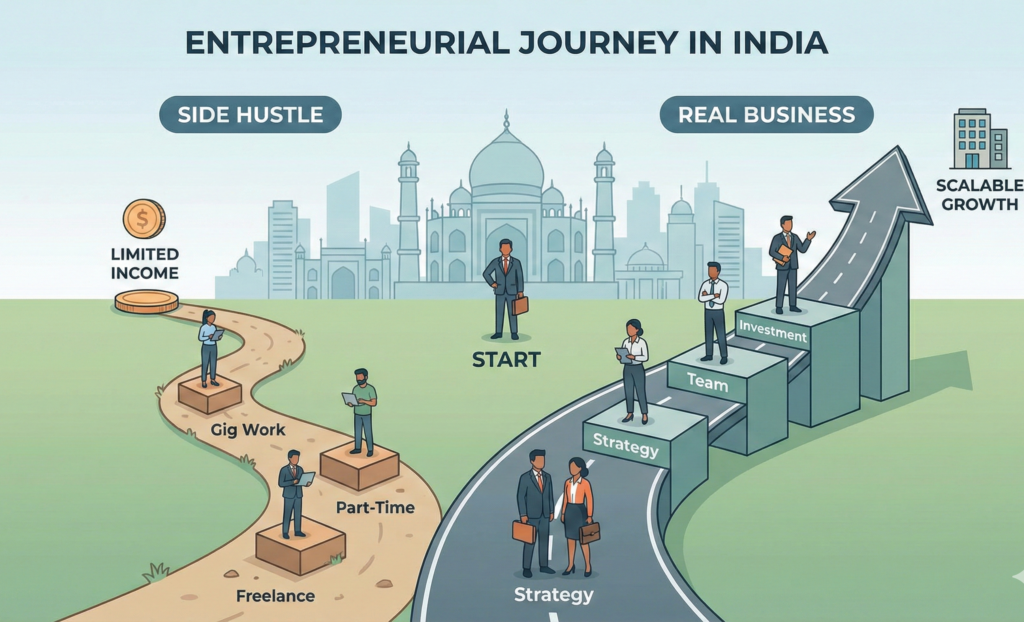
Side Hustle vs Real Business: What’s the Difference The debate around side hustle vs real business has become increasingly common in India. Social media often glorifies side hustles as quick income solutions, while traditional businesses are seen as risky and complex. However, many people confuse the two. Understanding the difference is critical before investing time, money, and energy. This article explains what separates a side hustle from a real business, how income behaves in each case, and which approach aligns better with long-term financial growth. What Is a Side Hustle A side hustle is an activity done alongside a primary job or occupation to earn extra income. It is usually time-dependent and skill-based. Common examples include freelancing, tutoring, content creation, delivery services, and small online gigs. Side hustles are easy to start and require low initial investment. Most people choose them because they offer flexibility and quick earnings without major risk. However, side hustles usually rely heavily on personal time. When time stops, income stops. What Is a Real Business A real business is built with systems, processes, and scalability in mind. It is designed to grow beyond the individual’s daily involvement. A business generates income through repeatable models such as products, services, platforms, or structured partnerships. Unlike side hustles, businesses focus on long-term value creation. They involve upfront planning, learning, and sometimes capital, but they offer the possibility of compounding income over time. Core Difference Between Side Hustle and Real Business The biggest difference in the side hustle vs real business comparison is income behavior. Side hustles produce linear income. You trade time for money. If you work more hours, you earn more. If you stop, income stops. A real business produces scalable income. Systems, teams, and processes allow growth without a proportional increase in personal time. This single difference determines long-term outcomes. Income Potential Comparison Side hustles typically have income limits. Freelancers may increase rates, but they still face time constraints. Burnout becomes a common issue. Businesses, on the other hand, have no fixed income ceiling. Growth depends on market demand, operational efficiency, and execution. This does not mean businesses guarantee high income. It means they allow it. Risk and Stability Perspective Side hustles feel safer because they require low investment. However, they are often unstable. Platform changes, client loss, or health issues can instantly stop income. Businesses carry higher initial risk but offer greater control. With diversified customers and structured operations, income stability improves over time. Risk is not about avoiding investment. It is about reducing dependency. Time Involvement and Lifestyle Impact Side hustles demand continuous personal involvement. Even successful hustlers remain busy handling tasks themselves. A real business initially requires high effort but gradually reduces dependency on the founder. Delegation and automation become possible. This difference impacts lifestyle, stress levels, and long-term sustainability. Skill Development Difference Side hustles usually sharpen one or two skills such as writing, teaching, or design. Businesses force broader learning. Sales, marketing, operations, leadership, and financial management become essential. This skill expansion increases long-term career value even beyond business outcomes. Why Most People Stay Stuck in Side Hustles Many people never transition from side hustle to business because they prioritize comfort over growth. Side hustles provide immediate income but discourage system-building. Without reinvestment and planning, they remain small. Another reason is lack of guidance. Building a real business without structure leads to confusion and early failure. When a Side Hustle Makes Sense Side hustles are ideal when the goal is short-term income, experimentation, or skill testing. They are useful for students, early professionals, or anyone exploring interests with minimal risk. However, expecting a side hustle to create long-term wealth often leads to disappointment. When a Real Business Makes Sense A real business is suitable when the goal is income growth, ownership, and independence. It requires patience, capital discipline, and learning. The rewards come later but are more sustainable. For professionals facing income stagnation, structured business models offer a transition path without quitting jobs abruptly. Side Hustle to Business Transition Many successful businesses start as side hustles but evolve intentionally. The transition happens when the focus shifts from doing work to building systems. Pricing, delegation, and branding become priorities. This shift separates earners from builders. Final Verdict The side hustle vs real business debate is not about choosing one over the other blindly. It is about clarity. Side hustles offer flexibility and quick income but limited growth. Real businesses demand effort and planning but offer scalability and ownership. Understanding the difference helps individuals align actions with goals. The mistake is not choosing a side hustle. The mistake is expecting it to behave like a real business.

How to start a business while doing a job in India step by step
Blog

How to Start a Business While Doing a Job (Step-by-Step Guide 2026)

Starting a business while doing a job is no longer an exception in India. With rising living costs, slow salary growth, and limited career upside, many professionals are looking for ways to build an additional income stream without risking their primary salary. Learning how to start a business while doing a job requires clarity, discipline, and realistic expectations. This guide explains the process step by step, covering mindset, legal considerations, time management, and business models that work best for working professionals. Why Starting a Business While Doing a Job Makes Sense A full-time job provides stability but often limits income growth. Most professionals experience incremental salary hikes, while expenses grow faster over time. Starting a business alongside a job allows you to build long-term income potential without giving up financial security. The key advantage of this approach is risk management. You experiment, learn, and build systems while your job continues to fund your living expenses. This reduces pressure and increases your chances of success. Step 1: Choose the Right Business Model Not all businesses are suitable for job-holders. Avoid models that demand full-day involvement or unpredictable schedules. The best businesses to start while doing a job share three traits. They are skill-based, system-driven, and scalable. Examples include consulting, coaching, education services, digital marketing, content-led businesses, and structured partner models. These allow flexible hours and can be scaled gradually. Avoid businesses that require daily physical presence, heavy inventory, or continuous supervision in the early stages. Step 2: Check Employment and Legal Constraints Before starting, review your employment contract carefully. Some companies restrict outside business activities, especially those related to the same industry. If there is a conflict clause, ensure your business does not compete with your employer or use company resources. Transparency and ethical separation are critical. From a legal standpoint, many professionals begin as sole proprietors. This simplifies compliance and allows easy income reporting. As revenue grows, the structure can evolve. Step 3: Manage Time Without Burning Out Time management is the biggest challenge when starting a business while doing a job. Successful professionals follow a fixed routine. Early mornings, late evenings, or weekends become focused work slots. Consistency matters more than long hours. Instead of trying to do everything, prioritize high-impact activities such as customer acquisition, service delivery, and system creation. Avoid unnecessary tasks that drain energy without moving the business forward. Step 4: Start Small but Think Long Term One common mistake is expecting fast results. Side businesses take time to mature. The initial goal is not high income but validation. You want to confirm that customers are willing to pay and that the business model works with limited time. Once validation is achieved, you can refine pricing, improve systems, and gradually increase involvement. This phased approach prevents frustration and reduces the risk of quitting too early. Step 5: Separate Job Income and Business Finances Financial discipline is essential when running a business alongside a job. Keep business income and expenses separate from personal accounts. Reinvest early profits instead of spending them. This accelerates growth and builds stability. Your job income should continue to cover personal expenses, while business income is used to strengthen operations and marketing. This separation creates clarity and prevents emotional decision-making. Step 6: Build Systems, Not Dependency A business that depends entirely on your time cannot scale. Focus early on creating repeatable processes. Document workflows, standardize services, and use simple automation tools where possible. The objective is to reduce dependence on daily involvement so that the business grows even when your job demands attention. This step determines whether your side business remains small or evolves into a full-time opportunity. Step 7: Learn Business Skills Actively Many professionals fail not because of lack of effort, but because of lack of business knowledge. Sales, marketing, pricing, customer psychology, and operations are critical skills. Learning these intentionally shortens the trial-and-error phase. Structured learning environments and mentorship-based programs significantly improve outcomes compared to self-learning alone. Step 8: Know When to Transition Quitting a job too early is risky. Staying too long can limit growth. A smart transition happens when business income becomes consistent and systems are stable. Many professionals wait until business income reaches at least 1.5 to 2 times their salary before considering a full-time shift. The decision should be data-driven, not emotional. Common Mistakes to Avoid Many people underestimate effort and overestimate speed. Others choose the wrong business model or ignore legal constraints. Trying to copy someone else’s journey without considering personal strengths is another common error. Every business path is individual and requires customization. Avoid comparing early-stage business income with long-term job income. They operate on different timelines. Final Thoughts Learning how to start a business while doing a job is about patience, structure, and intelligent risk management. Jobs provide stability. Businesses create scalability. Combining both strategically allows professionals to build income, skills, and confidence without unnecessary pressure. With the right model, disciplined execution, and continuous learning, a side business can evolve into a sustainable long-term opportunity. The goal is not to escape a job overnight, but to design a future with options.

Blog

Job vs Business in India: Income Growth Comparison (Data Study 2026)

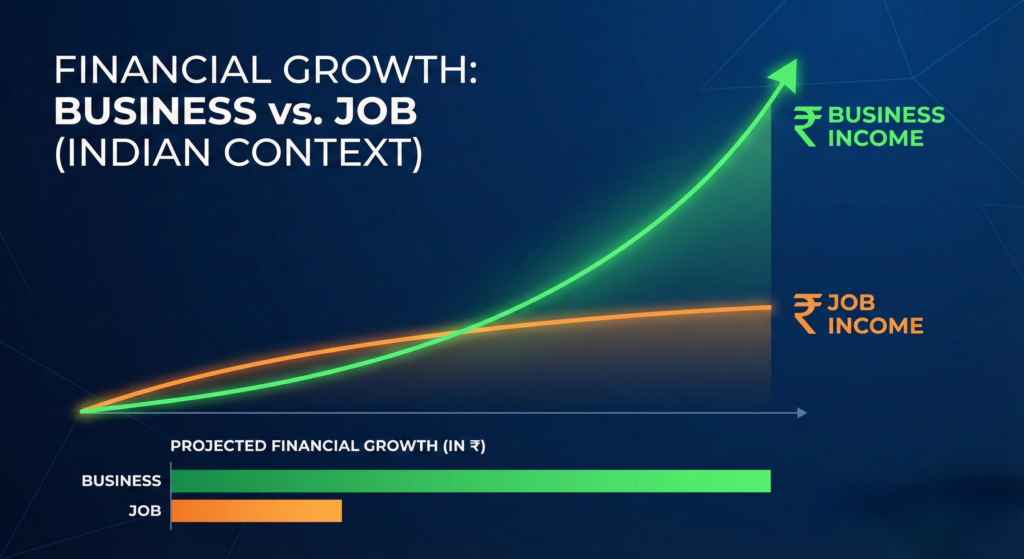
Job vs business income growth is one of the most discussed questions among working professionals in India today. While jobs offer stability, businesses promise scalability. But beyond opinions and motivation, what does the data actually say? This article breaks down the reality using three clear, data-backed charts. Each chart highlights a different stage of the income journey, from salary growth trends to long-term wealth creation and finally to structured business ownership through a proven education-led model. The goal is not to glorify risk or undermine jobs, but to help readers understand income behaviour over time and make informed decisions. Understanding Job Income Growth in India Average Salary Growth of Indian Employees A 10-Year Analysis The first chart highlights average salary growth across entry-level, mid-level, and senior-level professionals over a 10-year period in India. The data shows a consistent but slow upward movement. Entry-level professionals start around ₹3.6 lakh annually and reach approximately ₹5.4 lakh after a decade. Mid-level professionals grow from roughly ₹7.2 lakh to ₹10.8 lakh. Senior-level professionals increase from around ₹12 lakh to ₹14.5 lakh. This chart clearly demonstrates that job income grows steadily, usually between 6% to 10% annually. However, it also reveals a plateau effect. As professionals move deeper into their careers, income growth slows unless there is a major role change, industry switch, or overseas opportunity. The key insight from this chart is predictability. Job income is stable and structured, but its upside is limited by hierarchy, company budgets, and market cycles. Why Salary Growth Often Plateaus Mid-Career For most professionals, income progression is linear. Promotions take time. Salary hikes are incremental. Even high performers face ceilings. This is not a flaw in the job system. It is simply how structured employment works. Companies optimize for sustainability, not exponential income growth for individuals. This reality pushes many professionals to explore entrepreneurship, consulting, or side businesses. However, traditional businesses often fail because people underestimate risk, overestimate speed, and lack a system. This is where income growth comparison becomes important. Job vs Business Income Growth Over Time The second chart compares job income growth with business income growth over a 10-year period. Job income starts higher and grows slowly. Business income often starts lower but compounds rapidly over time. The chart clearly shows that in the early years, job income looks more attractive. From year four onwards, business income begins to overtake job income. By year ten, the gap becomes significant. This chart does not suggest that business is easy or guaranteed. Instead, it shows the power of scalability. A business is not limited by fixed increments. Growth depends on systems, execution, market reach, and skill leverage. This explains why individuals with successful businesses often earn disproportionately more after several years compared to salaried professionals. The Missing Piece: Why Most People Still Fail in Business If business income grows faster, why does everyone not become an entrepreneur? Because most people start businesses without structure. They start with no system, no mentorship, no brand support, and no proven process. As a result, early losses force them to quit before compounding can begin. This is why structured business models matter, especially for first-time entrepreneurs transitioning from jobs. Structured Entrepreneurship as a Middle Path The third chart introduces a structured alternative. It compares job income growth with a CSB Authorized Partner business model based on a 10-year proven education framework. The data clearly shows that the CSB Authorized Partner model starts with zero income during the setup phase. It requires an upfront investment of approximately ₹9 lakh. This is a business, not a shortcut. However, once operational, the income curve accelerates rapidly. Within three months, partners can start earning up to ₹3 lakh per month depending on execution, local demand, and effort. Over the years, income shows 100% to 150% year-on-year growth potential, unlike jobs where growth remains capped. The chart visually communicates one important truth. Structured businesses reduce chaos but do not eliminate hard work. The growth is real, but so is the effort. Why the CSB Authorized Partner Model Is Different Unlike traditional businesses, this model is built on education, training, and a demand-driven ecosystem refined over ten years. Partners do not start from scratch. They operate within a researched framework that includes curriculum, brand positioning, marketing systems, and mentorship support. This does not remove risk. It reduces uncertainty. For professionals stuck in salary plateaus but hesitant about unstructured entrepreneurship, this model provides a transition path from employee to business owner with defined systems. Job or Business: Making the Right Choice Choosing between job and business should never be emotional. It should be based on risk tolerance, financial readiness, skill level, and long-term goals. Jobs are ideal for those who value stability, predictable income, and lower risk. Businesses suit individuals who can commit time, capital, and effort with a long-term mindset. The charts in this article show one clear pattern. Income in jobs grows slowly but safely. Income in business grows faster but demands responsibility. Structured business models bridge the gap for those who want growth without chaos. Final Takeaway The job vs business income growth debate is not about right or wrong. It is about alignment. Data shows that jobs provide security but limited upside. Businesses provide scalability but require patience, capital, and execution. Structured models like the CSB Authorized Partner program demonstrate how risk can be managed through systems and experience. Before making any decision, individuals should assess their financial cushion, learning ability, and willingness to commit. Income growth is not accidental. It is designed.

sales skills for entrepreneurs
Blog

Sales Skills Every Young Entrepreneur Must Master

Sales Skills for Entrepreneurs: Why They Matter Today Sales skills for entrepreneurs are the foundation of every successful business. No matter how innovative your product or service is, it will fail without the ability to sell. For young entrepreneurs, sales is not just a department—it is a survival skill. In the early stages of a business, founders are the primary salespeople. Learning sales skills early helps entrepreneurs validate ideas, acquire customers, and generate cash flow without depending on large teams or external funding. Why Sales Skills for Entrepreneurs Are More Important Than Ever Markets today are competitive, fast-moving, and customer-driven. Entrepreneurs who master sales skills can: Without sales skills, even technically strong entrepreneurs struggle to survive. 1. Communication Skills: The Core of Sales Skills for Entrepreneurs Clear communication is the first and most important sales skill. Entrepreneurs must be able to: Good communication reduces objections and increases customer confidence. 2. Understanding Customer Psychology Sales skills for entrepreneurs go beyond talking—they require listening. Young entrepreneurs must learn to: When entrepreneurs understand customer psychology, selling becomes problem-solving, not persuasion. 3. Prospecting and Lead Generation Skills No sales process works without leads. Entrepreneurs should master: Consistent prospecting ensures steady business growth instead of random results. 4. Sales Pitching Skills for Entrepreneurs A strong sales pitch is: Sales skills for entrepreneurs include crafting pitches that: Young founders should practice pitching until it feels natural, not scripted. 5. Negotiation Skills Every Entrepreneur Needs Negotiation is not about winning—it’s about reaching mutually beneficial outcomes. Entrepreneurs must learn to: Strong negotiation skills protect profitability and brand perception. 6. Objection Handling: A Critical Sales Skill for Entrepreneurs Customers often say: Sales skills for entrepreneurs include learning how to: Objections are signals—not rejections. 7. Relationship Building and Trust Creation Long-term business success depends on repeat customers and referrals. Entrepreneurs should focus on: Trust converts one-time buyers into long-term clients. 8. Closing Skills: Turning Conversations Into Revenue Many young entrepreneurs struggle with closing. Sales skills for entrepreneurs include: Closing is not pushy—it is guiding customers toward a decision. 9. Sales Process and Systems Entrepreneurs must build simple sales systems early. This includes: A system-driven approach prevents missed opportunities and inconsistent results. 10. Learning Sales Through Real-World Practice Sales skills cannot be learned from theory alone. Young entrepreneurs should: Institutions like Catalyst School of Business (CSB) emphasize practical sales exposure, helping entrepreneurs develop real-world selling confidence. Common Sales Mistakes Young Entrepreneurs Make Avoiding these mistakes accelerates sales growth. How Strong Sales Skills Help Entrepreneurs Scale Faster Sales skills for entrepreneurs enable: Entrepreneurs who master sales build businesses that survive market changes. Final Thoughts: Master Sales Skills Early Sales is not optional—it is essential. Young entrepreneurs who develop sales skills for entrepreneurs early gain independence, confidence, and control over their business journey. Whether you are building a startup, service business, or personal brand, sales will always remain your most valuable skill. Learn it early. Practice it daily. Use it ethically.

/entrepreneurial-skills-for-students/
Blog

Entrepreneurial Skills College Students Must Learn to Succeed in Business

College is no longer just about getting a degree and finding a job. Today, many successful founders, startup owners, and business leaders began their entrepreneurial journey while still in college. Learning entrepreneurial skills for college students early provides a massive advantage. It allows students to: In a rapidly changing economy, skills matter more than certificates. This article explains the most important skills college students must learn to become successful entrepreneurs—practical, real-world, and relevant in 2026 and beyond. 1. Problem-Solving Skills (The Foundation of Entrepreneurship) Entrepreneurship begins with identifying and solving problems. Every successful business exists because it solves a real pain point: College students should train themselves to: Strong problem-solving skills help students validate business ideas before wasting time or money. 2. Communication Skills for Entrepreneurs Clear communication is one of the most underrated entrepreneurship skills in college. Students must learn to: Whether you are selling a product, hiring a team, or raising funds, communication decides outcomes. How students can improve: 3. Financial Literacy and Money Management Many student businesses fail not because of bad ideas—but because of poor money management. Entrepreneurial students must understand: Learning finance early helps students run sustainable businesses instead of burning money blindly. 4. Sales Skills (The Most Important Entrepreneurial Skill) No sales = no business. Sales is not manipulation—it is the skill of: Every entrepreneur, especially students, must learn sales. Ways students can practice sales: Sales experience builds confidence and real-world exposure faster than any textbook. 5. Digital Marketing Skills In today’s world, marketing is digital-first. College students aiming for entrepreneurship must learn: Digital marketing allows students to start businesses with low investment and high reach. It also enables: 6. Decision-Making and Risk Assessment Entrepreneurs make decisions daily—often with incomplete information. Students must develop the ability to: Entrepreneurship is not about avoiding failure; it’s about learning faster than others. Colleges rarely teach decision-making under uncertainty—students must develop this skill intentionally. 7. Time Management and Discipline Balancing studies, business, and personal life is challenging. Entrepreneurial students need: Without discipline, even the best ideas fail. Students who master time management early often outperform peers in both academics and business. 8. Networking and Relationship Building Success in business is rarely solo. Students must learn how to: Networking opens doors to: Platforms like LinkedIn, events, workshops, and business communities are excellent starting points. 9. Adaptability and Learning Mindset Markets change. Technology evolves. Consumer behavior shifts. The most successful student entrepreneurs are: Instead of asking “What should I study?”, entrepreneurs ask: “What skill should I learn next?” This mindset separates job-seekers from business builders. 10. Leadership and Team Management As student businesses grow, founders must lead teams. Leadership skills include: Students who learn leadership early build businesses that scale beyond themselves. 11. Understanding Legal and Business Basics Entrepreneurial students should also understand: This protects businesses from legal issues and builds credibility. 12. Execution Over Perfection Many students delay starting because they want everything “perfect.” Entrepreneurs succeed by: Execution matters more than ideas. College is the safest time to experiment, fail, and learn. How Colleges and Institutions Can Support Entrepreneurial Skills Forward-thinking institutions like Catalyst School of Business (CSB) focus on: This approach helps students build real businesses, not just resumes. Conclusion: Start Learning Entrepreneurial Skills Early The future belongs to creators, builders, and problem-solvers. College students who invest time in learning entrepreneurial skills gain: Degrees may open doors—but skills build businesses. Start early. Learn practically. Build real-world experience before graduation.

student entrepreneurs building real businesses
Blog

How Students Can Build Real Businesses Before Graduation (Proven Guide)

Students today no longer need to wait for a degree, job offer, or MBA to start a business. With access to digital tools, low-cost platforms, and real-world mentorship, students can build real businesses before graduation—businesses that generate revenue, customers, and practical experience. This article explains how students can build real businesses before graduation, step by step, without unrealistic hype or risky shortcuts. Whether you are in college, university, or your final year, this guide will help you think and act like a real entrepreneur. Why Students Should Build Real Businesses Before Graduation The traditional path—study, get a job, then think about business—no longer guarantees security. On the other hand, students who build businesses early gain: Most importantly, when students build real businesses before graduation, they stop depending entirely on placements and start creating options. What Does a “Real Business” Mean for Students? A real business is not: A real business has: Students don’t need huge capital. They need clarity, consistency, and execution. Step 1: Choose a Business Model Students Can Manage When students try to build real businesses, the biggest mistake is choosing ideas that are too complex or capital-heavy. Best business models for students: The goal is not scale on day one—it’s learning how business actually works. Step 2: Solve a Real Problem You Understand Students already live in multiple problem-rich environments: Successful student entrepreneurs identify pain points they see daily. Examples: When students build real businesses around familiar problems, execution becomes easier. Step 3: Start Small, But Charge From Day One Many students delay charging money because they feel “not ready.”This mindset blocks real learning. Charging money: Even ₹2,000–₹5,000 per client is enough to turn a student project into a real business. Step 4: Learn Business Skills Alongside Academics To build real businesses before graduation, students must develop business skills, not just technical skills. Key skills include: These skills are rarely taught properly in colleges—but they decide business success. Step 5: Use Digital Platforms to Build Visibility Students have one major advantage: time + digital fluency. Platforms students can use: Consistency matters more than perfection.When students show their journey publicly, trust builds naturally. Step 6: Build Systems, Not Just Hustle A common trap for student entrepreneurs is working randomly without systems. To build real businesses, students should: Systems reduce burnout and allow students to manage business alongside studies. Step 7: Balance College and Business Strategically Building a business before graduation does not mean ignoring academics. Smart student entrepreneurs: The goal is sustainable progress, not overnight success. Step 8: Learn From Mentors Who Have Built Businesses Students often learn from: What actually helps is learning from people who have built, failed, and scaled real businesses. Mentorship reduces mistakes, speeds up learning, and provides clarity. Step 9: Focus on Profit, Not Just Ideas Ideas don’t build businesses—profits do. Students should track: Even small profits teach more than big ideas with no execution. When students build real businesses before graduation, they understand money practically—not just academically. Step 10: Use the Business as a Career Asset Even if a student decides not to continue the business full-time, the experience becomes a powerful asset. Benefits include: Many successful founders started businesses as students—not to become rich overnight, but to learn early. Common Mistakes Students Should Avoid Avoiding these mistakes increases the chances of building a real, sustainable business. Why Building a Business Before Graduation Matters More Than Ever The future favors: Students who build real businesses before graduation don’t just prepare for jobs—they prepare for ownership, leadership, and independence. Final Thoughts Building a real business as a student is not about shortcuts or hype. It’s about: Students who take this path graduate with something more valuable than a certificate—real-world business experience.

Earn 1 Lakh rupees profit as student
Blog

How to Make Your First ₹1 Lakh Profit as a Student Entrepreneur

Making your first ₹1 lakh profit as a student entrepreneur is more achievable in 2026 than ever before. You don’t need heavy investment, a fancy office, or connections. You need clarity, skills, consistency, and a smart business model that works while you’re still in college. Whether you’re studying engineering, BBA, BCom, arts, or even preparing for competitive exams, this guide will show the exact step-by-step path to earn your first lakh — ethically, sustainably, and fast. ⭐ Why Student Entrepreneurs Have an Advantage Most students mistakenly feel they “lack experience.”In reality, students have massive advantages: 1. Low personal financial responsibilities You can take small risks that adults with families cannot. 2. Easy access to peers as first customers Your college itself becomes your test market. 3. You learn faster than older entrepreneurs Young brains adapt to digital tools, trends, and skills instantly. 4. You can start a business with ₹0–₹5,000 Most student businesses today require skills, not capital. If you have smart execution and patience, your first ₹1 lakh profit can come in weeks or months. 🧩 Step 1: Choose a Business Model That Can Make ₹1 Lakh Fast Here are the 6 most realistic, proven & profitable models for students in India. 1. Freelancing (Digital Skills Business) Perfect for:Students with skills like editing, designing, writing, or social media. Popular services: Income potential:₹15,000 – ₹80,000 per clientYour first lakh? Possible in 1–2 months. 2. Reselling (Zero-Investment Selling Business) You can sell: You do not keep inventory. You just connect buyers and sellers. Income potential:₹15,000 – ₹50,000 per monthLow risk + high margin → great for beginners. 3. College Campus Services Business You can start simple but highly demanded services: Income potential:₹30,000 – ₹1,00,000 per month depending on hustle. 4. Content Creation + Monetization YouTube, Instagram, LinkedIn, Twitter (X), or blogging. Monetization options: Income potential:₹20,000 – ₹2,00,000/monthSlow to start, huge upside. 5. Online Teaching / Micro Coaching If you know: You can teach students online for ₹300–₹1,500/hour. Income potential:₹20,000 – ₹1,00,000/month. 6. Import-Export Micro Business Even as a student, you can start a micro-import or micro-export service. Examples: For full export business, join a proper training like CSB’s IBTC Program (Internal link suggestion). 🎯 Step 2: Follow the “₹1 Lakh Profit Formula” Here’s a simple formula that works for students: Profit = (High-Demand Skill/Service) × (Consistency) × (Pricing Strategy) Breakdown: ❇️ Pick 1 skill or business❇️ Get your first 3–5 clients❇️ Raise pricing every 2–3 projects❇️ Improve skills → repeat Students who follow this earn ₹1 lakh faster than those who try 10 things at once. 💸 Step 3: Pricing Strategy That Helps You Hit ₹1 Lakh Use this ladder: Stage 1 — Start (₹500 – ₹1,500) Get first clients, build portfolio. Stage 2 — Growth (₹5,000 – ₹15,000) After 3–4 clients, raise pricing. Stage 3 — Premium (₹20,000 – ₹50,000) For high-value services like: At stage 3, earning ₹1 lakh takes just 2–5 clients. 🚀 Step 4: How to Get Your First 10 Customers (Fast) 1. Use Instagram + LinkedIn Post samples, reels, and your portfolio. 2. Use Fiverr + Upwork Freelancers earn globally while studying. 3. Tell friends you’re offering a service Your inner circle can be your first sales engine. 4. DM businesses with value Send: 5. Join college groups College clubs, societies, and events need services every week. 📍 Step 5: Build a System That Can Run While You Study To make ₹1 lakh consistently, system > effort. Build: This will make you look professional and increase trust. 🧠 Mindset Shift: Why Most Students Never Earn ₹1 Lakh Not because they lack skills. But because they:❌ overthink❌ try too many things❌ expect fast results❌ fear rejection❌ don’t market themselves The ones who win are not the most talented —they are the most consistent and visible. 🏆 Conclusion Your first ₹1 lakh profit as a student entrepreneur is not luck — it is a system. Pick one business. Build skill. Market loud. Deliver well.Your first lakh will come faster than you think. And if you want structured mentorship, consider learning with CSB’s entrepreneurship & export programs

Scroll to Top