

Starting a business without external funding may sound risky, but in reality, some of India’s largest companies—Zoho, Zerodha, InfoEdge—were bootstrapped for many years before they became profitable. Today, the rise of digital tools, low-cost marketing channels, and simplified compliance has made it easier than ever to build a bootstrapped business in India.
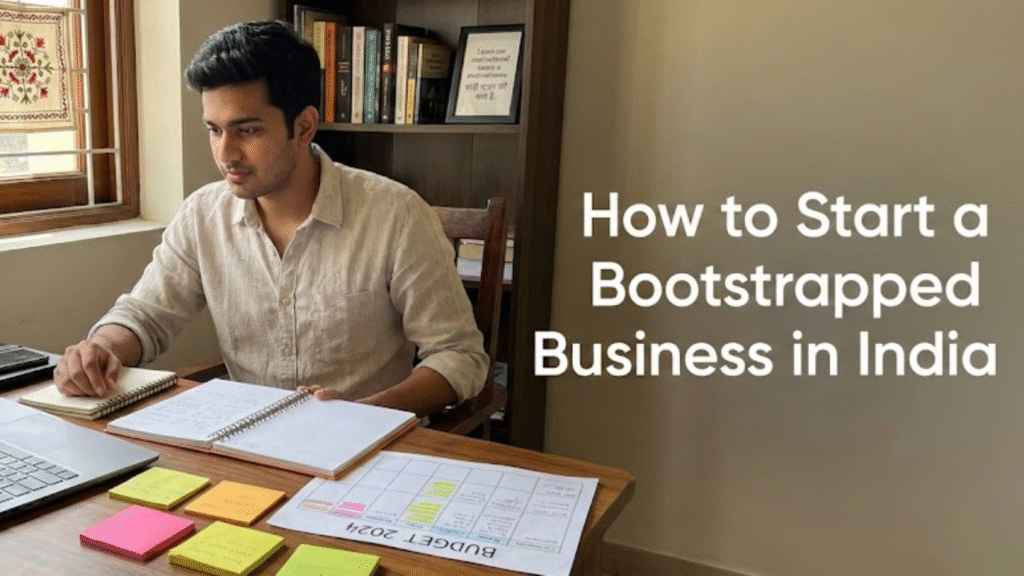
This guide will walk you through everything you need to know—mindset, planning, product building, marketing, finances, legal setup, and scaling—without depending on investors.
🧭 What Is a Bootstrapped Business?
A bootstrapped business is a company that grows using its own internal cash flow, personal savings, or early customer revenue—not external investment.
In India, bootstrapping is becoming more popular because:
- Funding is limited to top-tier startups
- Founders want more control
- Digital tools reduce setup and marketing costs
- Profitable businesses are valued more than “burn-heavy” ones
Bootstrapping forces you to think like a real entrepreneur:
- Spend carefully
- Build what customers actually want
- Generate money early
- Grow step-by-step, not overnight
🧘 1. Build a Strong Bootstrapped Founder Mindset
Before you dive into execution, the mindset matters more than anything.
Bootstrapped founders must learn to:
- Execute fast
- Make decisions with limited resources
- Reduce perfectionism
- Sell from Day 1
- Use frugal innovation (“jugaad”)
- Work with small teams or no team
The Indian startup ecosystem glorifies funding, but the entrepreneurship system rewards cash flow, not pitch decks.
🧠 2. Validate Your Business Idea Without Spending Money
The biggest mistake new entrepreneurs make is burning money before validation.
Use these low-cost validation methods:
a) Talk to potential customers
Interview 20–30 people who match your target audience.
Ask:
- “What problem are you facing?”
- “How are you solving it today?”
- “Would you pay for a better solution?”
b) Create a WhatsApp group/MVP
Don’t build a full product. Start with a basic service, Google Form, Notion page, or WhatsApp workflow.
c) Pre-sell before building
This is the secret sauce of bootstrapped founders.
If someone pays you before you build the product → you’re on the right path.
⚙️ 3. Choose a Bootstrapped-Friendly Business Model
Some business models require heavy capital. Avoid them.
Best bootstrapped business models in India (2026):
- Service businesses
- Digital products
- Consulting/coaching
- Freelancing + agency
- Content + community monetization
- Niche e-commerce (small inventory)
- SME B2B solutions
Avoid these if you are bootstrapping:
- Manufacturing (high CapEx)
- Logistics-heavy businesses
- Tech startups requiring R&D
- Marketplace platforms with high burn
💰 4. Start Small: Minimum Viable Product (MVP)
Your MVP should be the simplest version of your product that delivers the core value.
Examples:
- Course: Start with Zoom + Google Drive
- E-commerce: Sell on Instagram before building a website
- App idea: Use no-code tools (Tally, Glide, Bubble, Wix)
- Agency: 1 service → 1 niche → 1 result
The goal is not perfection but customer feedback.
📣 5. Market Your Bootstrapped Business on a Small Budget
Marketing is where most new businesses waste money.
Here are low-cost strategies that work in India:
a) Leverage WhatsApp
WhatsApp is the easiest platform for early traction:
- Create a WhatsApp Business profile
- Use Catalog + Quick Replies
- Join relevant groups
- Build a broadcast list
- Share testimonials early
b) Build Authority on Social Media
Pick one platform, not five.
Choose based on your audience:
- Instagram → B2C
- LinkedIn → B2B
- YouTube → Long-term authority
- Twitter → Tech / Startup community
Post consistently for 60 days before judging results.
c) Content SEO (like this blog)
Publishing blogs targeting long-tail keywords is a sustainable growth engine.
Example topics for a bootstrapped founder:
- “How to launch a service business in India”
- “Best digital tools for small businesses”
- “How to get your first 10 paying customers”
d) Cold Email + Cold DM
Bootstrapped businesses grow on early direct outreach.
Send 30–50 cold DMs every week on LinkedIn or Instagram.
📊 6. Handle Finances Like a Bootstrapped Entrepreneur
Managing money is the heart of a bootstrapped business.
Follow the 30-30-40 Formula:
- 30% → Operations
- 30% → Marketing & growth
- 40% → Profit/salary buffer
Build a 6-month runway
Keep some money aside for:
- Emergencies
- Slow months
- New tools
- Hiring interns
Never burn money assuming you’ll “fix it later.”
⚖️ 7. Register Your Business (Low-Cost Options)
You don’t need to create a Pvt Ltd on Day 1. Start simple.
Best legal structures for bootstrapped businesses:
- Sole Proprietorship — easiest, cheapest
- Partnership Firm — for co-founders
- LLP — simple and investor-friendly later
- Pvt Ltd — only if you need credibility/sales contracts
Additional essentials:
- GST (if turnover > ₹20 lakh or selling online)
- Udyam Registration
- Trademark (optional in early months)
- Business current account
Keep compliance low in the beginning.
👥 8. Build a Tiny but Effective Team (or Work Solo)
Instead of hiring full-time employees, choose:
- Freelancers
- Part-time assistants
- Interns
- Contract-based roles
Tools for affordable productivity:
- Notion
- Trello
- Zoho Suite
- Canva
- Google Workspace
📦 9. Start Selling Early — Don’t Wait
Revenue is the oxygen of a bootstrapped business in India.
Most founders delay selling because they want everything perfect.
Here’s the formula for early sales:
- Build → Sell → Fix → Sell → Improve → Sell
- Repeat for 6 months
- Build customer loyalty
- Ask for testimonials
- Create referrals
Even ₹20,000–₹50,000/month early revenue is enough to survive your first quarter.
📈 10. Scale Your Bootstrapped Business Sustainably
Scaling should be slow, steady, and profitable.
Ways to scale:
- Add new services/products
- Increase prices for premium clients
- Build systems (SOPs, templates)
- Automate marketing
- Outsource repetitive work
The goal is not to grow fast — it’s to grow profitably.
💡 Examples of Bootstrapped Success Stories From India
India has multiple bootstrapped legends:
- Zerodha – ₹9,000 crore revenue, no funding
- Zoho – 150M+ users, self-funded
- InfoEdge – built Naukri.com profitably
- Razorpay (initial years) – founders started by building small merchant solutions
The pattern is clear:
Bootstrapped founders build profitable companies while investor-funded founders build burn-heavy ones.
⭐ Conclusion: Starting a Bootstrapped Business in India Is Simpler Than You Think
You don’t need funding, a big office, or a massive team.
You need:
- A validated idea
- A simple MVP
- Early customers
- A strong mindset
- Discipline in execution
- A willingness to start small
A bootstrapped business in India succeeds when the founder focuses on solving problems, generating revenue, and building long-term systems not chasing investors.