

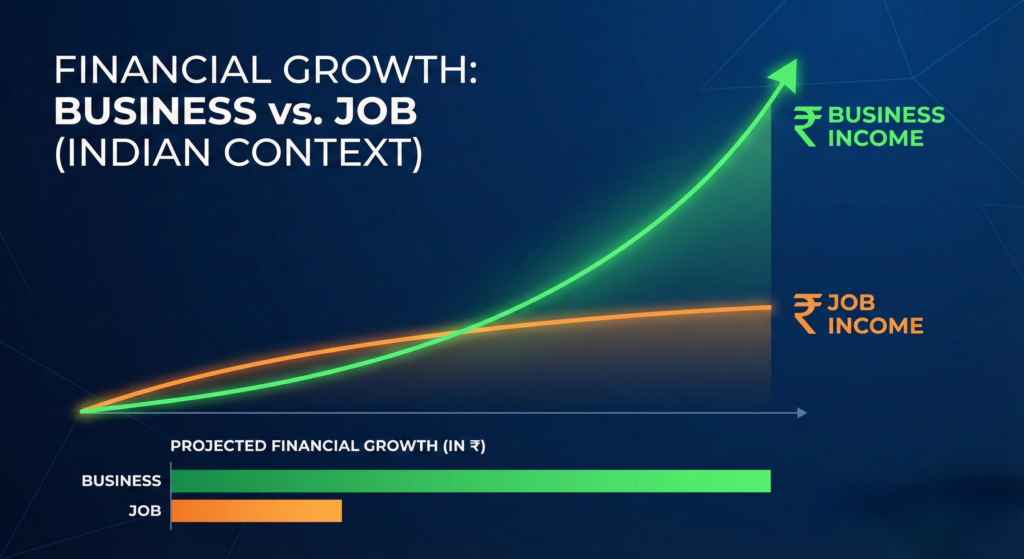
Job vs business income growth is one of the most discussed questions among working professionals in India today. While jobs offer stability, businesses promise scalability. But beyond opinions and motivation, what does the data actually say?
This article breaks down the reality using three clear, data-backed charts. Each chart highlights a different stage of the income journey, from salary growth trends to long-term wealth creation and finally to structured business ownership through a proven education-led model.
The goal is not to glorify risk or undermine jobs, but to help readers understand income behaviour over time and make informed decisions.
Understanding Job Income Growth in India
Average Salary Growth of Indian Employees A 10-Year Analysis
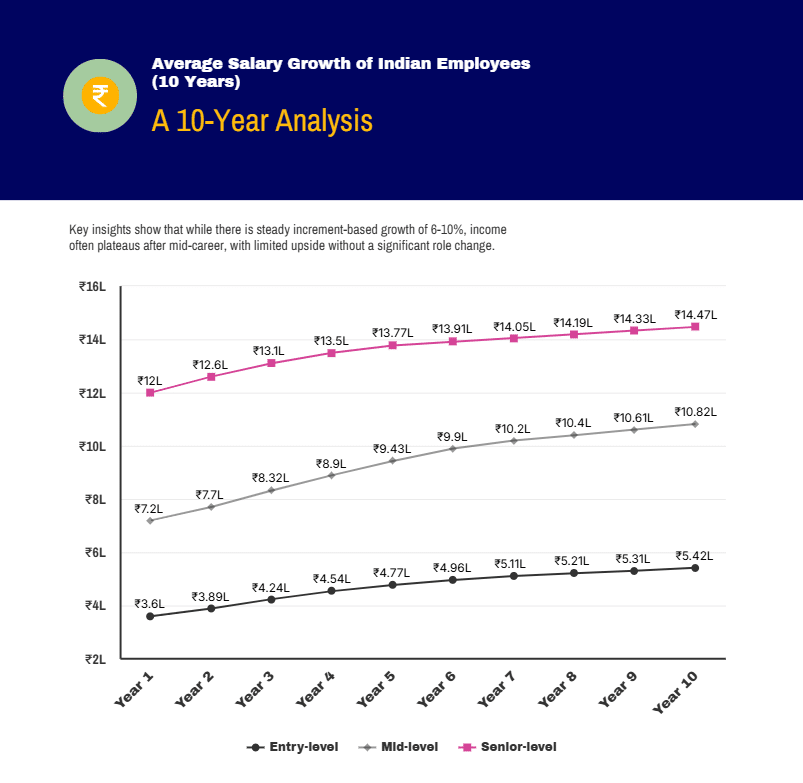
The first chart highlights average salary growth across entry-level, mid-level, and senior-level professionals over a 10-year period in India.
The data shows a consistent but slow upward movement. Entry-level professionals start around ₹3.6 lakh annually and reach approximately ₹5.4 lakh after a decade. Mid-level professionals grow from roughly ₹7.2 lakh to ₹10.8 lakh. Senior-level professionals increase from around ₹12 lakh to ₹14.5 lakh.
This chart clearly demonstrates that job income grows steadily, usually between 6% to 10% annually. However, it also reveals a plateau effect. As professionals move deeper into their careers, income growth slows unless there is a major role change, industry switch, or overseas opportunity.
The key insight from this chart is predictability. Job income is stable and structured, but its upside is limited by hierarchy, company budgets, and market cycles.
Why Salary Growth Often Plateaus Mid-Career
For most professionals, income progression is linear. Promotions take time. Salary hikes are incremental. Even high performers face ceilings.
This is not a flaw in the job system. It is simply how structured employment works. Companies optimize for sustainability, not exponential income growth for individuals.
This reality pushes many professionals to explore entrepreneurship, consulting, or side businesses. However, traditional businesses often fail because people underestimate risk, overestimate speed, and lack a system.
This is where income growth comparison becomes important.
Job vs Business Income Growth Over Time
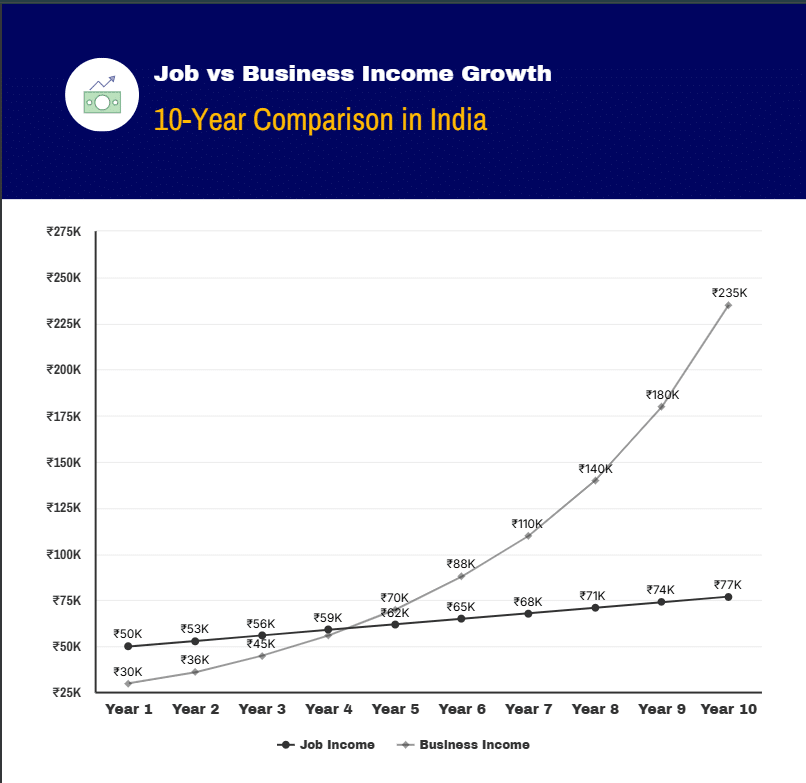
The second chart compares job income growth with business income growth over a 10-year period.
Job income starts higher and grows slowly. Business income often starts lower but compounds rapidly over time.
The chart clearly shows that in the early years, job income looks more attractive. From year four onwards, business income begins to overtake job income. By year ten, the gap becomes significant.
This chart does not suggest that business is easy or guaranteed. Instead, it shows the power of scalability. A business is not limited by fixed increments. Growth depends on systems, execution, market reach, and skill leverage.
This explains why individuals with successful businesses often earn disproportionately more after several years compared to salaried professionals.
The Missing Piece: Why Most People Still Fail in Business
If business income grows faster, why does everyone not become an entrepreneur?
Because most people start businesses without structure.
They start with no system, no mentorship, no brand support, and no proven process. As a result, early losses force them to quit before compounding can begin.
This is why structured business models matter, especially for first-time entrepreneurs transitioning from jobs.
Structured Entrepreneurship as a Middle Path
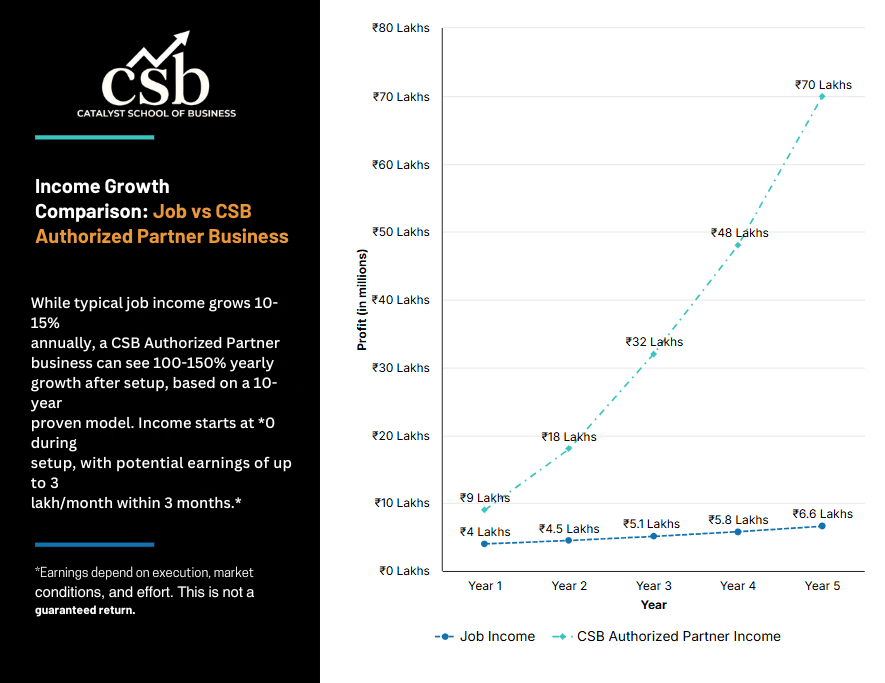
The third chart introduces a structured alternative. It compares job income growth with a CSB Authorized Partner business model based on a 10-year proven education framework.
The data clearly shows that the CSB Authorized Partner model starts with zero income during the setup phase. It requires an upfront investment of approximately ₹9 lakh. This is a business, not a shortcut.
However, once operational, the income curve accelerates rapidly. Within three months, partners can start earning up to ₹3 lakh per month depending on execution, local demand, and effort. Over the years, income shows 100% to 150% year-on-year growth potential, unlike jobs where growth remains capped.
The chart visually communicates one important truth. Structured businesses reduce chaos but do not eliminate hard work. The growth is real, but so is the effort.
Why the CSB Authorized Partner Model Is Different
Unlike traditional businesses, this model is built on education, training, and a demand-driven ecosystem refined over ten years.
Partners do not start from scratch. They operate within a researched framework that includes curriculum, brand positioning, marketing systems, and mentorship support.
This does not remove risk. It reduces uncertainty.
For professionals stuck in salary plateaus but hesitant about unstructured entrepreneurship, this model provides a transition path from employee to business owner with defined systems.
Job or Business: Making the Right Choice
Choosing between job and business should never be emotional. It should be based on risk tolerance, financial readiness, skill level, and long-term goals.
Jobs are ideal for those who value stability, predictable income, and lower risk. Businesses suit individuals who can commit time, capital, and effort with a long-term mindset.
The charts in this article show one clear pattern. Income in jobs grows slowly but safely. Income in business grows faster but demands responsibility.
Structured business models bridge the gap for those who want growth without chaos.
Final Takeaway
The job vs business income growth debate is not about right or wrong. It is about alignment.
Data shows that jobs provide security but limited upside. Businesses provide scalability but require patience, capital, and execution. Structured models like the CSB Authorized Partner program demonstrate how risk can be managed through systems and experience.
Before making any decision, individuals should assess their financial cushion, learning ability, and willingness to commit. Income growth is not accidental. It is designed.