

A six-figure income looks, on paper, like the finish line for financial worry. Good salary vs financial stability turns out to be a much weaker relationship than most people assume, and 2025 and 2026 survey data show high earners running out of money before the next paycheck at rates that would surprise anyone who thinks of income and stability as roughly the same thing.
The Data Behind Good Salary vs Financial Stability
The clearest evidence comes from a major retirement and income survey. The Goldman Sachs 2025 Retirement Survey and Insights Report, based on responses from over 5,100 people, found that about 40 per cent of workers earning more than $300,000 a year said they live paycheck to paycheck, a rate close to that of the lowest income group surveyed. A separate 2026 analysis found something even more counterintuitive: Americans earning $100,000 a year are now more likely to report living paycheck to paycheck than those earning $50,000, a reversal of what income alone would predict. Good salary vs financial stability isn’t a straight line upward. Past a certain point, more income stops automatically buying more breathing room.
What ‘Survival Mode’ Actually Looks Like at $200K
The discomfort at high income levels isn’t just a self-reported feeling with no real consequences behind it. Among households earning at least $200,000, 60 per cent report feeling like they’re in survival mode, and some in that group have delayed paying bills or postponed medical care specifically because of cost, according to 2026 research from SoFi. A 2025 Harris Poll found a similar pattern from a different angle: roughly one in three Americans with six-figure incomes reported experiencing genuine financial distress within the past year. None of this means high earners are struggling the way a minimum-wage household is. It means the specific feeling of running close to the edge financially shows up at income levels most people assume are well past that risk.
Lifestyle Inflation Is the Mechanism Behind the Number
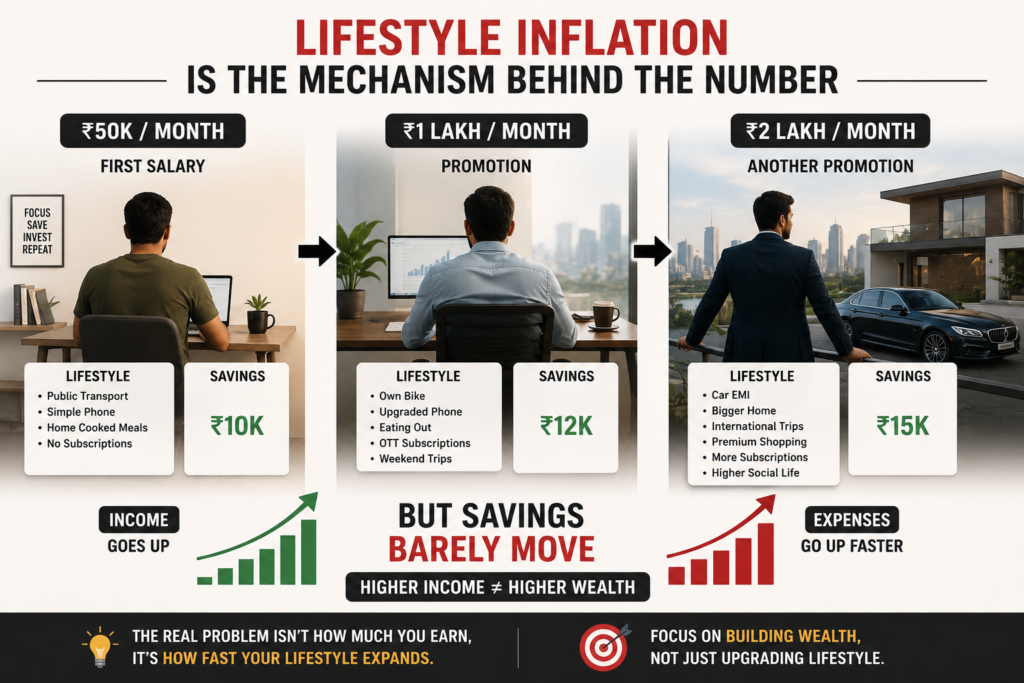
There’s a well-documented behavioural pattern that explains most of this gap: lifestyle inflation, sometimes called lifestyle creep, where spending rises in step with income until the raise stops producing any actual financial cushion. A new car replaces the old one, a bigger apartment replaces the smaller one, and small upgrades that each felt reasonable in isolation add up to a budget with no more slack at $250,000 than it had at $90,000. Financial commentators covering this pattern consistently point to the same fix: building a budget anchored to a prior, lower income level even after a raise arrives, so the difference between old and new earnings actually accumulates as savings rather than disappearing into upgraded spending before anyone notices it happened.
High-Income Debt Looks Different, But Isn’t Automatically Safer
One nuance is worth adding, honestly, since the picture isn’t uniformly grim at the top. High-income households carry the largest credit card balances in raw dollar terms, but at a debt-to-income ratio typically well under 2 per cent, compared to a household earning under $25,000 carrying a debt-to-income ratio on credit cards alone that can run above 16 per cent. In that narrow sense, debt genuinely is more manageable at higher income. But manageable debt-to-income math doesn’t automatically translate into savings or a cushion, which is exactly the disconnect the paycheck-to-paycheck data above captures: the math can look fine on a spreadsheet while the actual bank balance stays thin.
Why Income Alone Doesn’t Predict How Someone Handles Money
Part of what makes this pattern counterintuitive is that most financial advice implicitly assumes income is the constraint, that the real problem is simply not earning enough. The data above suggests the constraint is often behavioural rather than mathematical once income clears a basic threshold. A household earning $60,000 that has built a habit of saving a fixed percentage before spending anything else will often weather an unexpected expense more comfortably than a household earning $200,000 that has never built that habit, simply because the second household’s entire budget, including bills that scale with the higher income, absorbs the full paycheck by design. This is really the heart of good salary vs financial stability as a distinction: financial planners who work with high-income clients report this pattern often enough that it has its own informal name in the industry, sometimes called HENRY, standing for High Earner, Not Rich Yet, describing exactly this gap between income and accumulated wealth.
This isn’t an argument that income doesn’t matter, since a higher income obviously makes building savings easier in absolute terms when the habit is actually in place. It’s an argument that income and financial behaviour are two separate variables, and treating a raise or a high salary as automatically solving financial stability skips the step where the actual saving has to happen deliberately, not by default.
The Emergency Fund Gap Cuts Across Every Income Level
The clearest single measure of financial stability, an emergency fund, shows the same story from yet another direction. Bankrate’s 2026 Emergency Savings Report found that 27 per cent of US adults have zero emergency savings, 59 per cent couldn’t cover a $1,000 emergency expense from savings alone, and 29 per cent carry more credit card debt than they have set aside in savings. None of these figures is broken out as exclusively low-income problems, and the paycheck-to-paycheck data above confirms why: a household earning $250,000 with no consistent savings habit is structurally in the same position as a household earning $60,000 with the same habit, just with a larger number attached to the shortfall when an emergency actually arrives.
What Actually Builds Stability, Beyond Just Higher Income
The practical fix isn’t complicated to describe, even though it’s genuinely difficult to sustain once a lifestyle has already expanded to match an income. Closing the gap between good salary vs financial stability starts with treating a raise as partially invisible, routing a meaningful share of it directly into savings or investments before it ever reaches a checking account, which prevents the slow creep that turns a higher salary into the same financial tightness as before. Building an emergency fund as a fixed, non-negotiable line item rather than whatever’s left over after discretionary spending closes the exact gap the Bankrate data above describes. And reviewing recurring expenses, subscriptions, upgraded services, and financing payments on a regular schedule catches the accumulation of small commitments before they quietly become the reason a large income still feels tight every month.
A useful discipline that shows up repeatedly in financial planning guidance for this exact situation is separating a raise or bonus into thirds before deciding what to do with any of it: a portion toward savings or debt paydown, a portion toward a genuine lifestyle upgrade if one is actually wanted, and the rest simply left unallocated rather than absorbed automatically into higher fixed costs like a larger mortgage or a longer car lease. That structure doesn’t require earning more. It requires deciding, in advance, what happens to money that hasn’t already been spent by habit.
Conclusion
Good salary vs financial stability turns out to be two different things measured on two different axes, and the data from 2025 and 2026 makes that gap hard to dismiss: roughly 40 per cent of $300,000-plus earners and a majority of $200,000-plus households report living close to the financial edge despite income that would look, from the outside, like more than enough. A higher salary makes financial stability easier to build, but it doesn’t build it automatically. Whether income actually converts into stability comes down to what happens to every additional dollar the moment it arrives, not the size of the number on the paycheck itself.